

Delta is the first Greek everyone meets and the one almost everyone underestimates. It’s three tools in one — a speedometer, a rough probability gauge, and a measure of real exposure — and it’s the number that decides how many futures contracts the biggest hedgers in the world have to trade. Episode 2 of our Greeks series.

One number, three readings
In Episode 1 we called delta the option’s speed: how much the option’s price moves when the underlying moves one point. That’s reading number one, and it’s where every textbook stops.
But delta earns its place as the most-watched Greek because the same number can be read three ways. It’s a speedometer. It’s a rough probability gauge. And — the reading professionals actually trade on — it’s your real exposure, expressed in units of the underlying. Three readings, one number. Let’s take them in order.
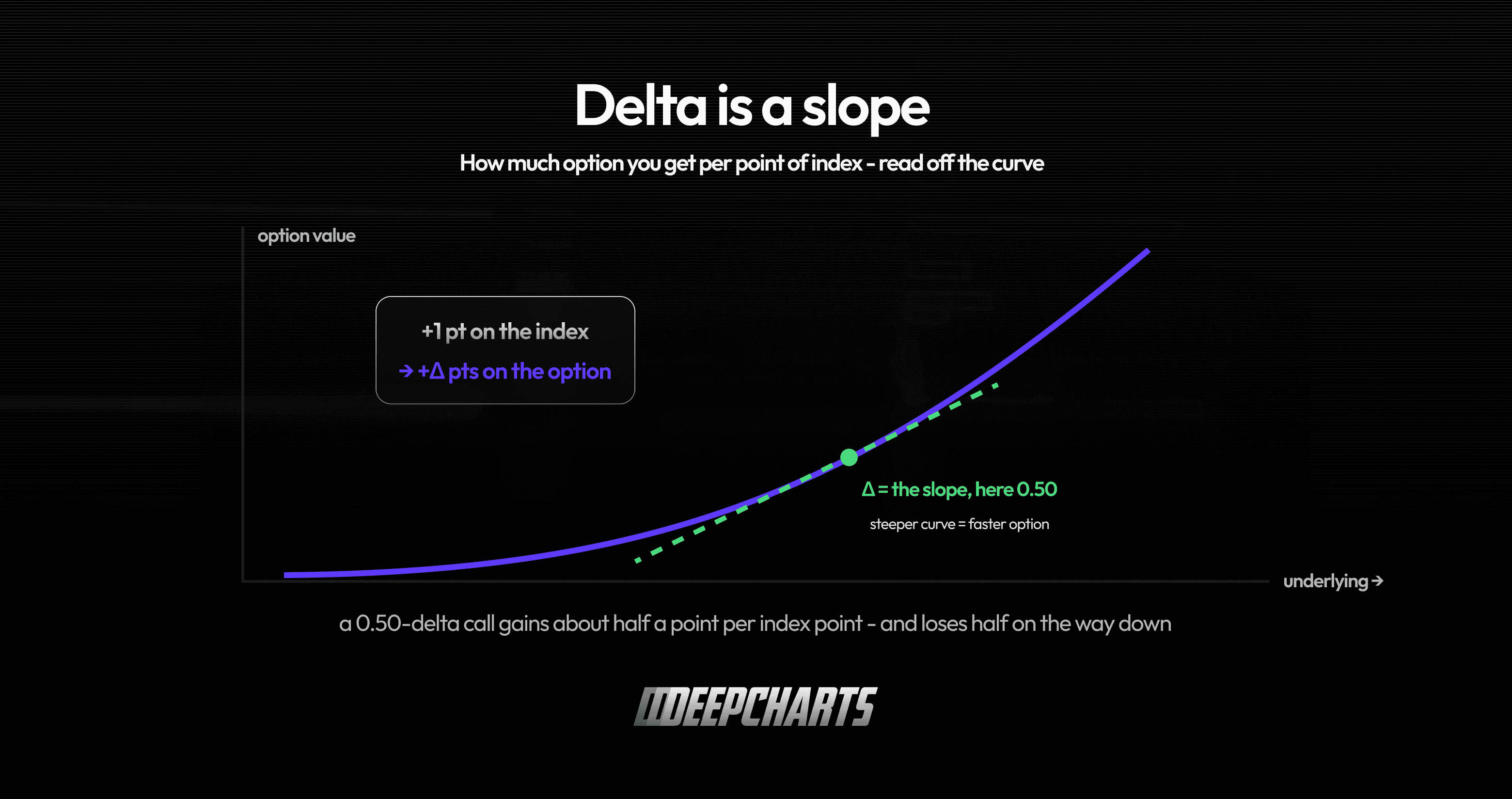
Figure 1 · Delta is a slope
Reading #1 — Speed
A call with a 0.50 delta gains about half a point when the index gains a point, and loses about half when it drops one. A put with a −0.30 delta gains 0.30 when the index falls a point. That’s the whole definition: points of option per point of underlying.
Delta lives between 0 and 1 for calls, 0 and −1 for puts, and it maps cleanly onto moneyness. Deep out-of-the-money: delta near zero — the index moves, your option shrugs. At the money: right around 0.50. Deep in the money: approaching 1 — the option stops behaving like an option and starts behaving like the index itself.
One habit worth building from day one: think of delta as a ladder, not a label. The same 6,000-strike call slides up and down that ladder as the index moves around it. The number you read at the open is not the number you’ll hold at lunch.
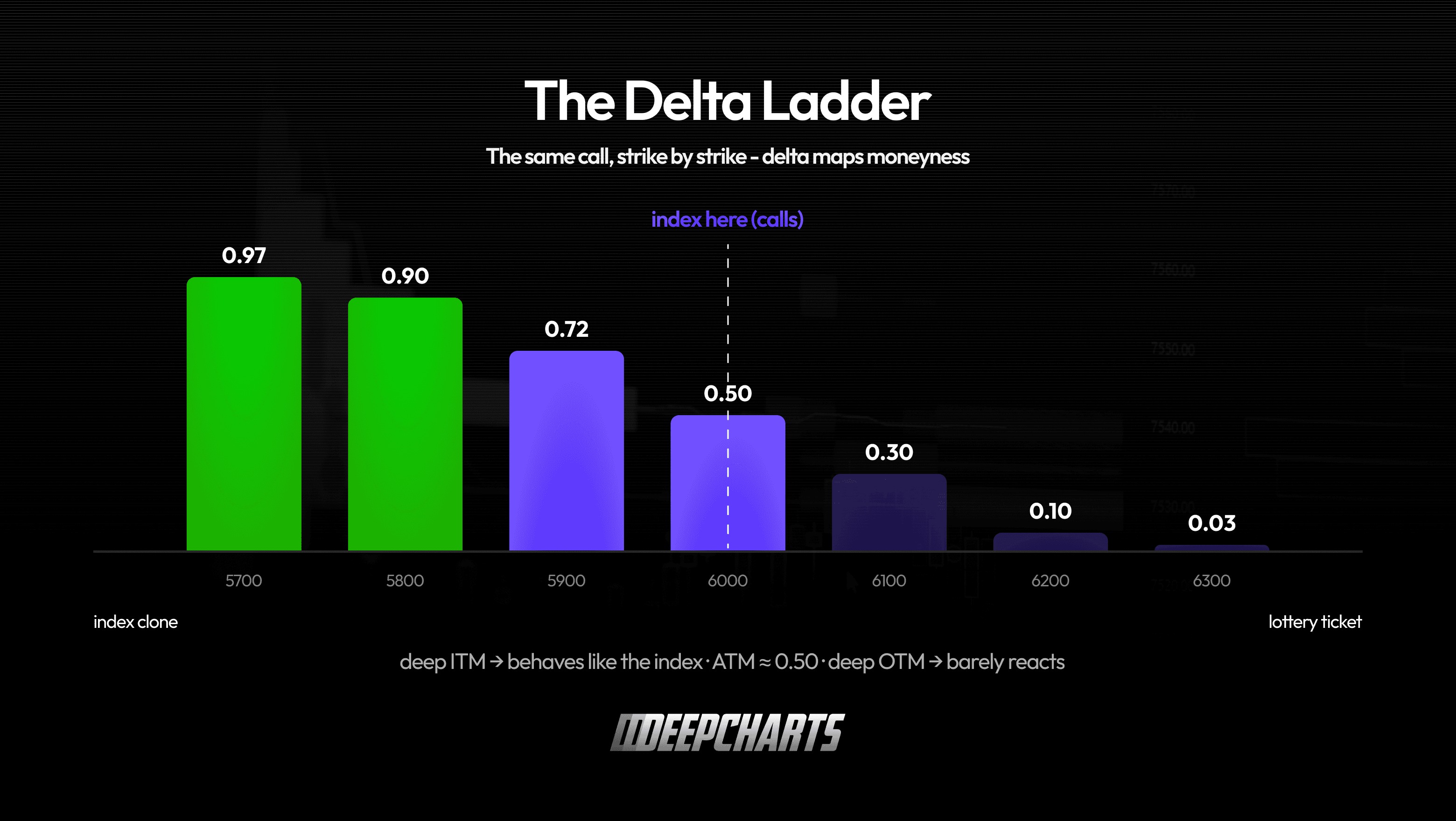
Figure 2 · The delta ladder
Reading #2 — Probability (the honest version)
Here’s the folk theorem every options desk uses and every textbook footnotes: delta is a rough proxy for the probability that the option expires in the money. A 0.30-delta call ≈ roughly a 30% chance of finishing in the money. A 0.90-delta call is almost certainly staying there.
Is that exactly true? No — and we care about the difference. The precise probability measure is a different quantity, the approximation drifts with volatility and time, and delta comes out of a pricing model in the first place. Treat it as a heuristic, not a law: good enough to instantly read “the market thinks this strike is a long shot” off a chain, not good enough to build a probability model on.
Why include the caveat in a beginner piece? Because reading numbers for what they are — measured, modeled, or estimated — is the entire skill. Delta is a modeled number. It’s a useful one precisely when you remember that.
Reading #3 — Exposure
Now the reading that moves real money. Because delta is “points per point”, it converts any option position into an equivalent position in the underlying:
contracts × multiplier × delta = units of the underlying.
Take 200 calls on the S&P 500 with a 0.50 delta and the standard 100 multiplier: 200 × 100 × 0.50 = 10,000 index units of exposure. Same directional risk, for small moves, as holding 10,000 “shares” of the index — or, in the language that matters here, about 200 ES contracts (each ES is worth ~50 index units).
This is the reading that makes delta additive. A book of thousands of different options — calls, puts, every strike, every expiry — collapses into one net delta: a single number that says “this whole portfolio is currently long 40,000 index units” or “short 12,000”. Traders call a book with net delta near zero delta-neutral: no directional bet, for now.
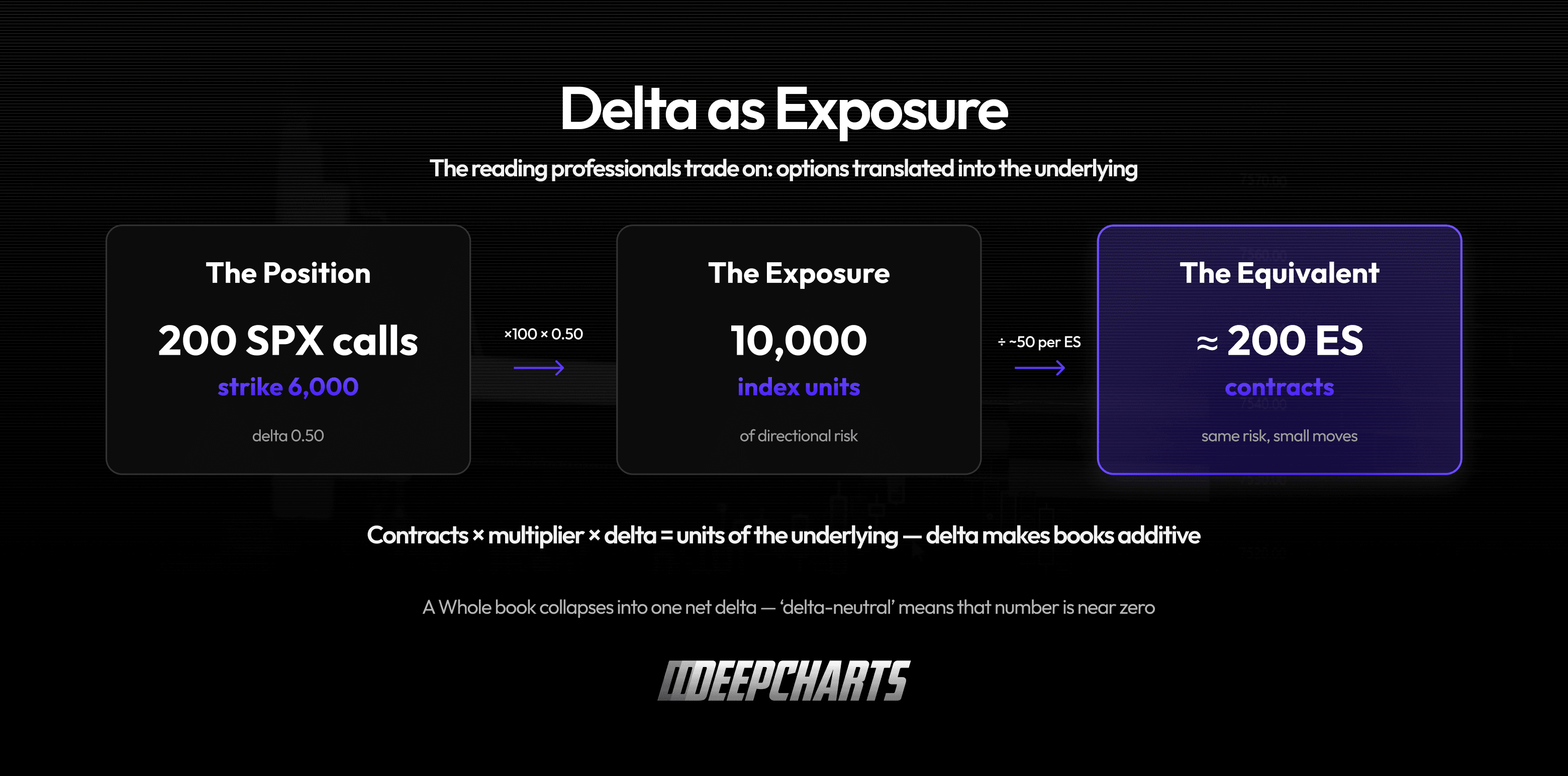
Figure 3 · Delta as exposure
The catch: delta is a moving target
If delta were constant, hedging would be a one-time errand. It isn’t, and the ways it moves have names — this series will meet them all.
Price moves it: that’s gamma, the acceleration we covered in Episode 1 and the star of the next episode. Time moves it: an out-of-the-money option’s delta bleeds toward zero as expiry approaches — that drift is called charm. Volatility moves it: when implied volatility shifts, the whole delta ladder re-prices — that’s vanna. Charm and vanna get their own episode later in this series, and by then you’ll see why desks watch them around big expirations.
For now, one idea is enough: a delta is a snapshot, not a setting. Whoever needs their delta to stay put has to keep trading to keep it there.
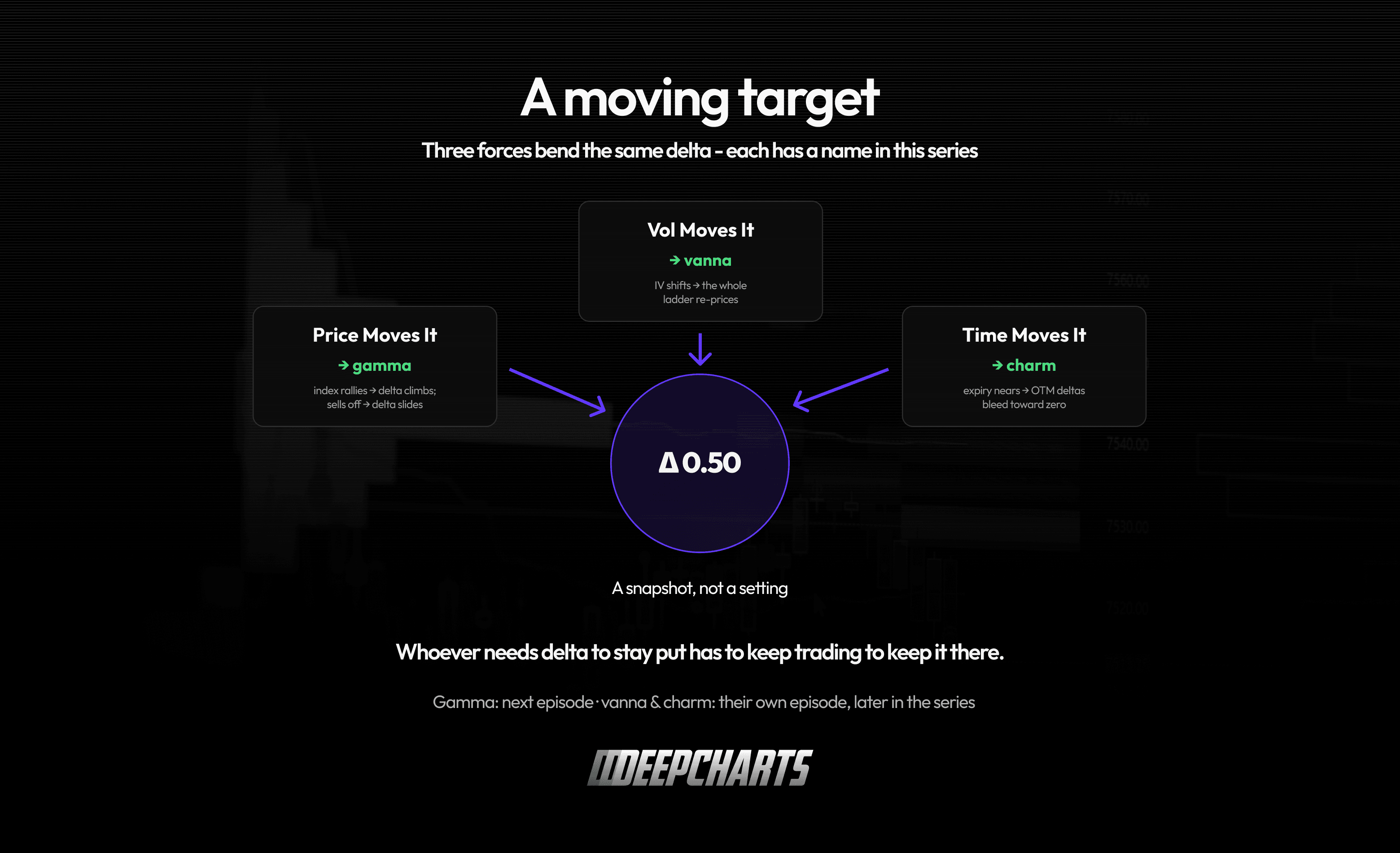
Figure 4 · A moving target
The dealer’s delta: where your futures come in
Put the pieces together and you arrive at the reason a futures platform is writing this series.
The market makers on the other side of the world’s index option flow run exactly the book we described: thousands of strikes, every expiry, constantly changing. They net it all into one number — the book’s delta — and because their business is collecting spread and premium rather than betting on direction, they neutralize that delta with index futures. The equivalence above isn’t a classroom exercise for them; it’s the day job. Short 25,000 index units against the book? Buy ~500 ES. Book shifts? Adjust.
Two properties of that flow make it worth a futures trader’s attention. It’s big — the index options market turns over more notional daily than the ES itself, so even hedged slices matter. And it’s forced — dealers don’t hedge because they have a view, they hedge because they have a book. Desks work within risk bands and net what can be netted, but the direction of the adjustment is not a choice: sooner or later, the book forces it.
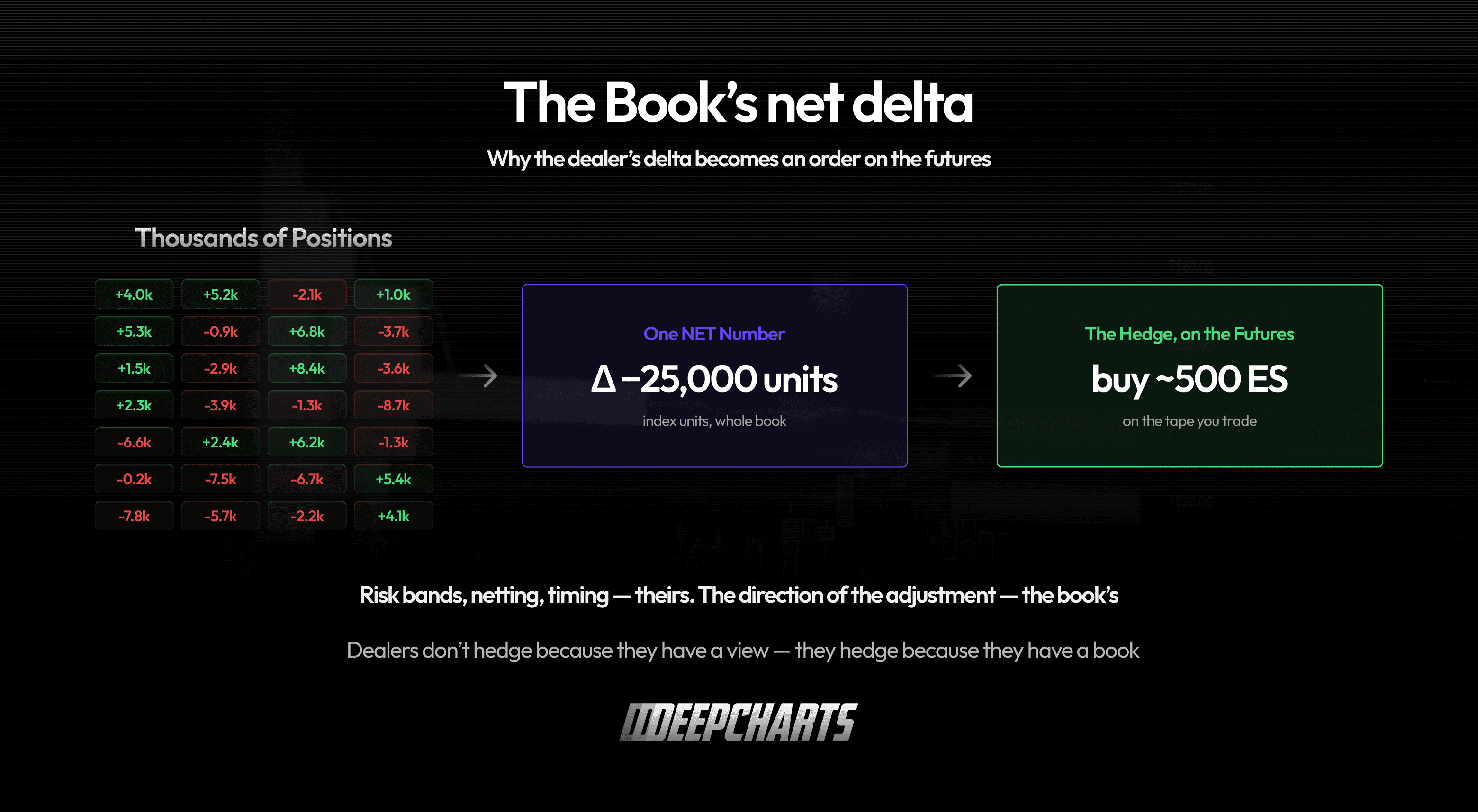
Figure 5 · The book’s net delta
What a futures trader does with this
You can’t see any single dealer’s book — nobody can. But the ingredients of the market’s net delta are public: which options are trading, at which strikes, in what size — and, on some exchange feeds, on which side. Sum the day’s flow through the session and you get cumulative option delta: a running estimate of the directional exposure the option market has been building, and therefore of the hedging pressure it implies on the futures.
That’s a concept worth knowing whatever software you chart with. It is not a prediction of price; it’s context with an address. When the option market has spent all morning accumulating positive delta, you know which way the mechanical adjustment leans if price starts moving — and you can go watch the tape at the levels where it should show up.
One number, three readings — and a fourth one, on the tape.
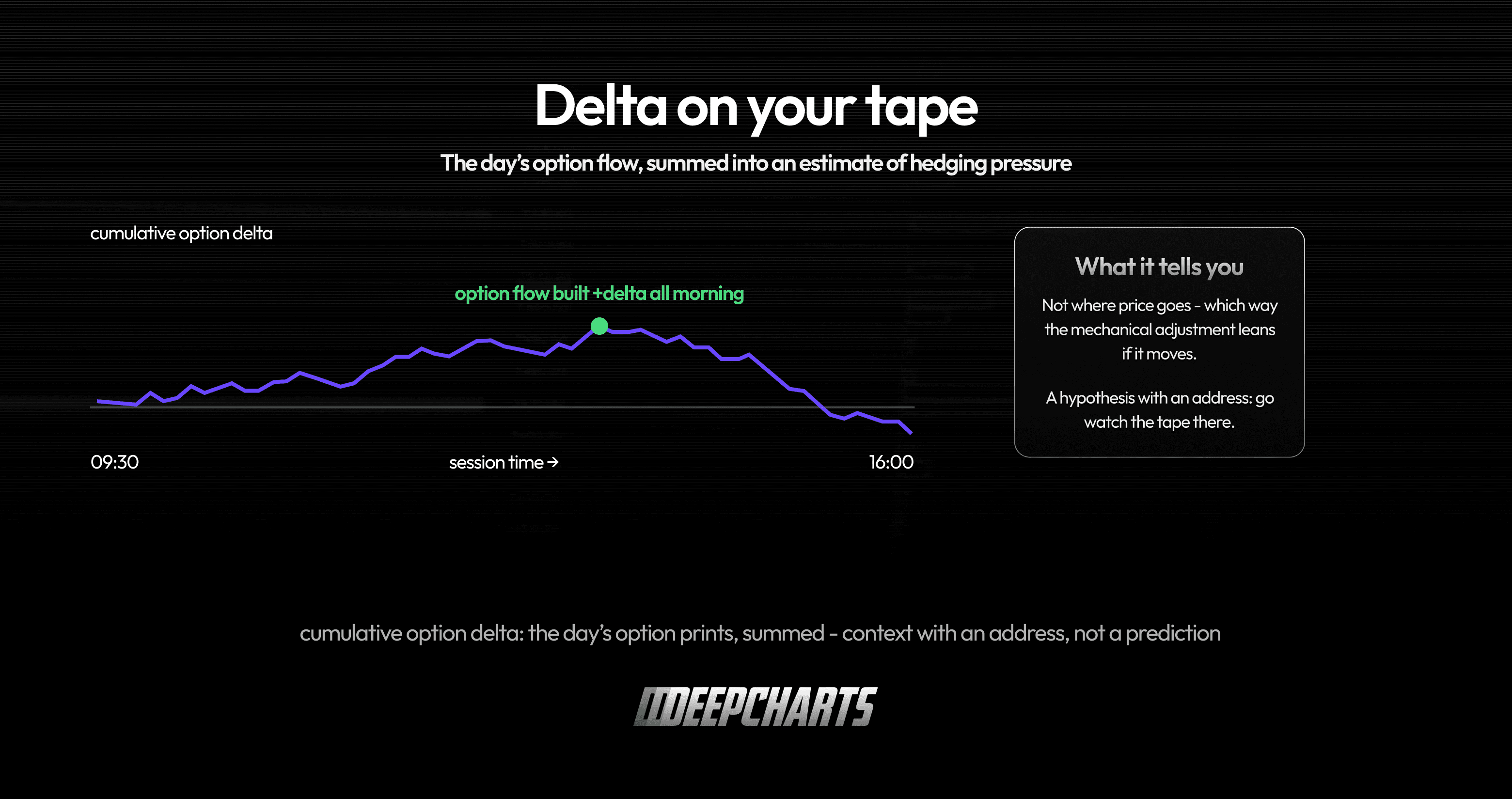
Figure 6 · Delta on your tape
FAQ
What is delta in options, in simple terms?
It’s how much an option’s price moves when the underlying moves one point. A 0.50-delta call gains about half a point per index point. It runs 0 to 1 for calls, 0 to −1 for puts.
Is delta the probability of expiring in the money?
Approximately, and only as a heuristic: a 0.30-delta option has roughly a 30% chance of finishing in the money. The exact probability is a different modeled quantity — use delta as a quick read, not a precise forecast.
What does delta-neutral mean?
A position (or a whole book) whose net delta is near zero: no directional exposure for small moves. Staying neutral requires continuous re-hedging, because delta changes as price, time and volatility move.
Why does delta matter for futures traders?
Because dealers neutralize the net delta of their option books with index futures. That hedging is large and mechanical, and estimating its direction — for example with cumulative option delta — tells you which way forced flow leans on the tape you trade.
What’s the difference between delta and gamma?
Delta is the speed (points per point); gamma is the acceleration (how fast delta itself changes). Gamma is why delta hedges have to be adjusted continuously — that’s the next episode.
Episode 3 takes on the Greek that made this whole series necessary: gamma — the acceleration that turns quiet books into forced buyers and sellers.
Deepcharts Team
·
Share this on
