



Two traders, same bullish view. One buys futures, one buys a call. The market decides who was right — but the shape of how right and how wrong they can be was decided the moment they picked the instrument. That shape is convexity: the most important idea in derivatives, and the thing every Greek so far has been circling. Episode 5 of our Greeks series.

Two traders, one move
Start with the experiment. The index trades at 6,000. Trader A buys one futures contract. Trader B spends the same risk budget on an at-the-money call.
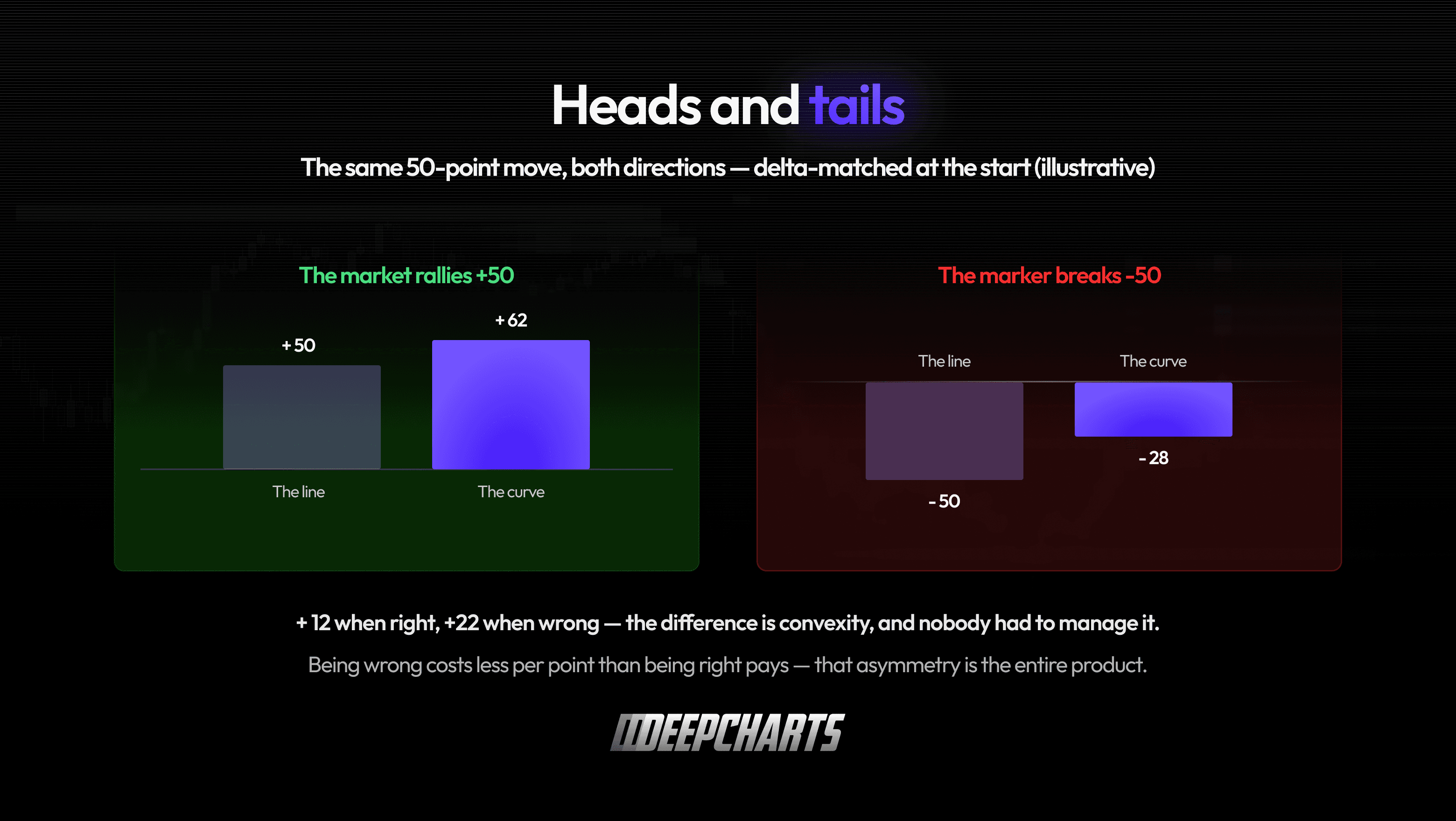
The market rallies 50 points. A makes 50 points — exactly, mechanically, one for one. B makes more with every point: her delta started around 0.50 and grew as the rally ran (Episode 3), so the last points paid better than the first.
Now run the tape backwards: a 50-point break instead. A loses 50 — again one for one; the line doesn't care about direction. B loses less with every point: her delta shrank into the fall, and no matter how ugly it gets, her loss stops at the premium she paid. There's a floor under her and open sky above.
Same view, same move. Different geometry. A owns a line. B owns a curve. Convexity is the name of that difference.
The line and the curve
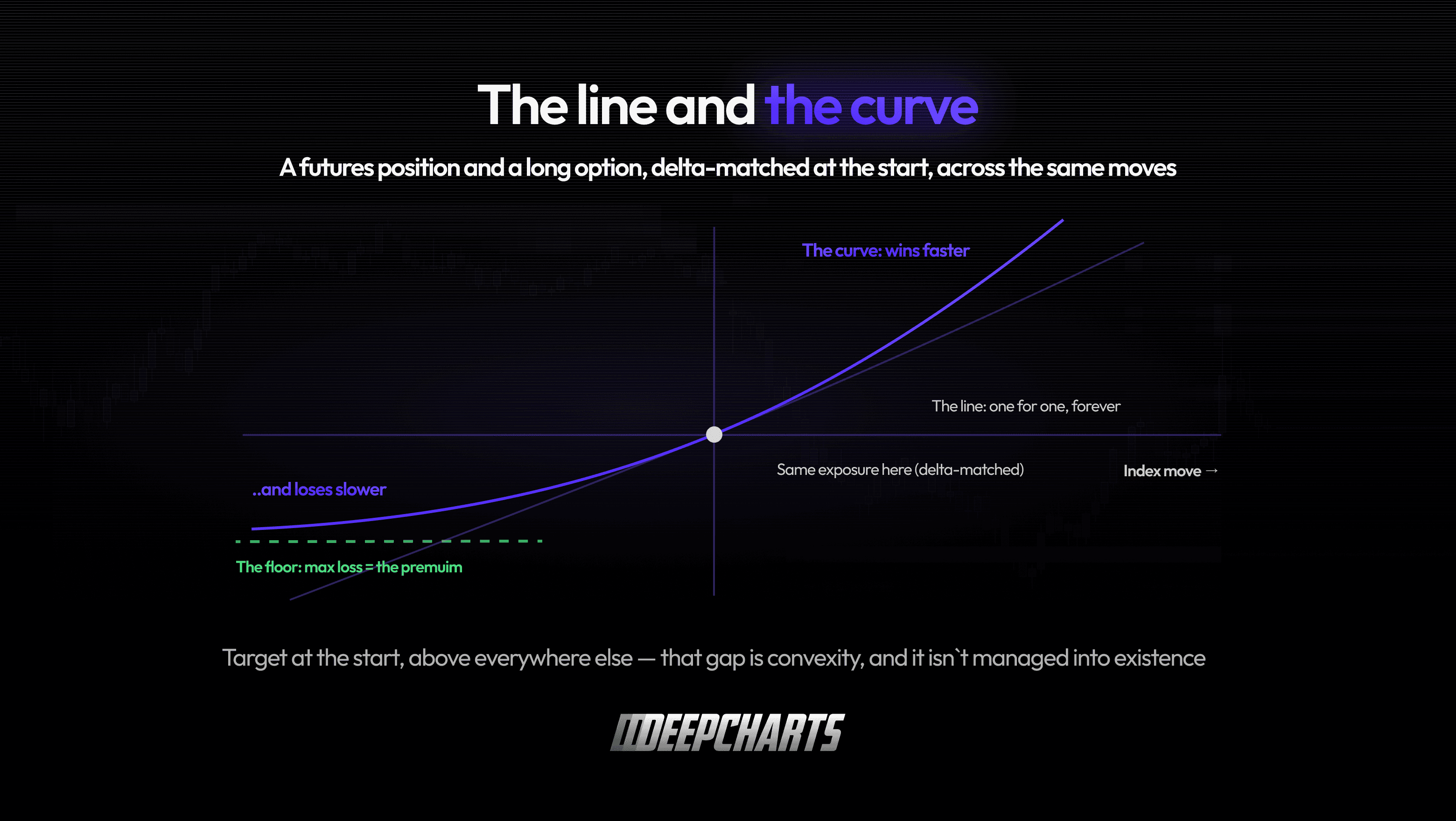
A futures position is linear: its delta is always 1 per contract, everywhere, forever. Its P&L per point is the same on the way up, on the way down, on quiet days and on panicked ones. Zero gamma, by construction. What you size is what you get.
A long option is convex: its exposure bends in your favor. When the market moves your way, your delta grows — you get automatically longer into a rally you were right about. When it moves against you, your delta shrinks — you get automatically smaller into the move that's hurting you. Heads, you win faster; tails, you lose slower.
Write that asymmetry down, because it's the entire product: convexity means being wrong costs less per point than being right pays. Nobody has to manage it into existence — the curve does it alone, tick by tick, without an order.
Where the Greeks fit
If this sounds familiar, it should — you've met the machinery already.
Gamma is convexity, measured locally. The bend of the curve at the point where you're standing (Episode 3). Saying "long options are long gamma" and "long options are convex" is saying the same thing at different zoom levels: gamma is the millimeter view, convexity is the shape of the whole road.
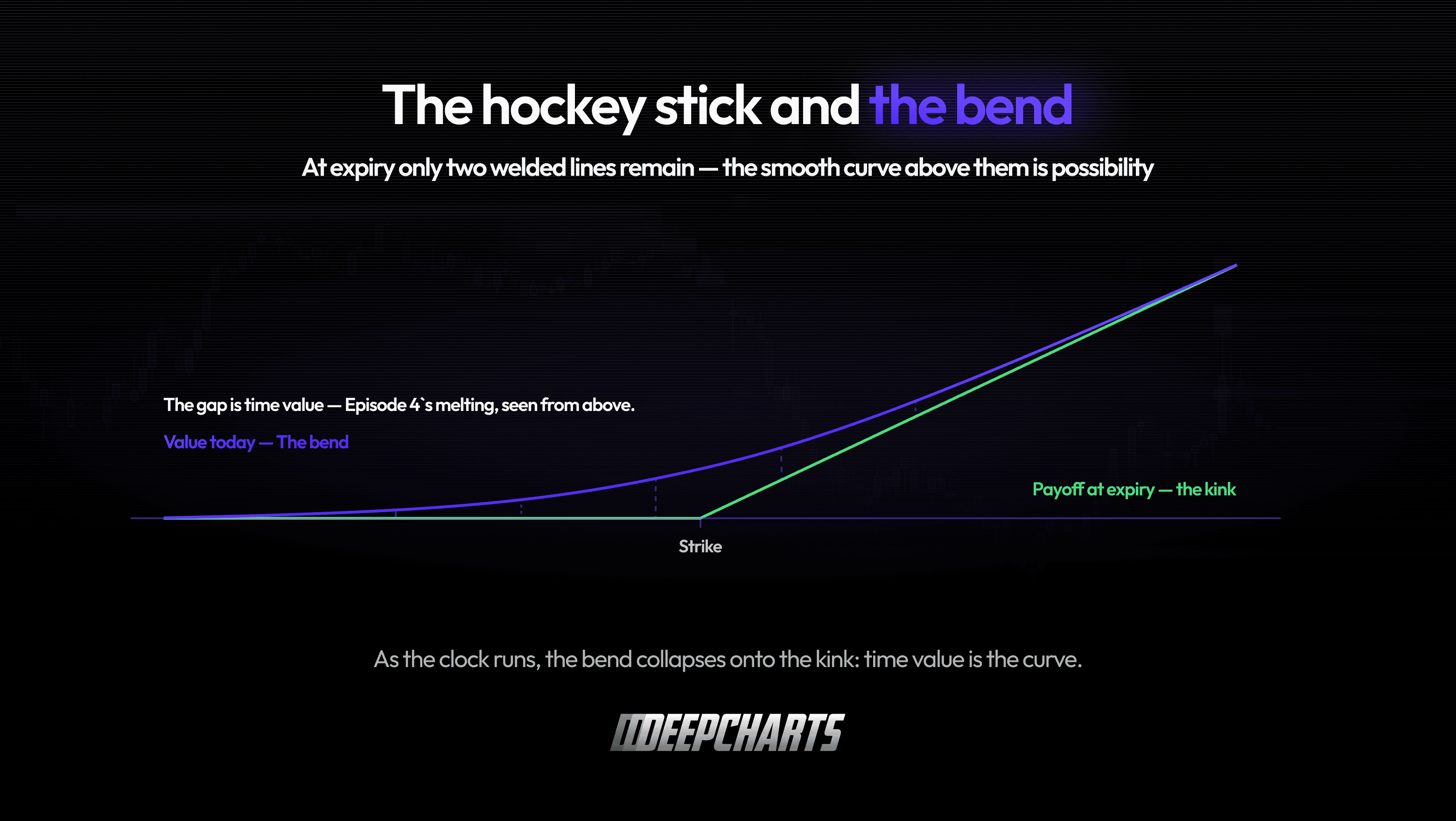
And the curve is a living thing. At expiration, an option's payoff is the famous hockey stick: flat, then a kink at the strike, then a straight line. No curve at all — just two lines welded together. The smooth bend you own before expiry is possibility itself: the market pricing every path that could still happen. As time passes, the bend collapses toward the kink — which is exactly the melting you watched in Episode 4. Time value is the curve.
Nothing bends for free
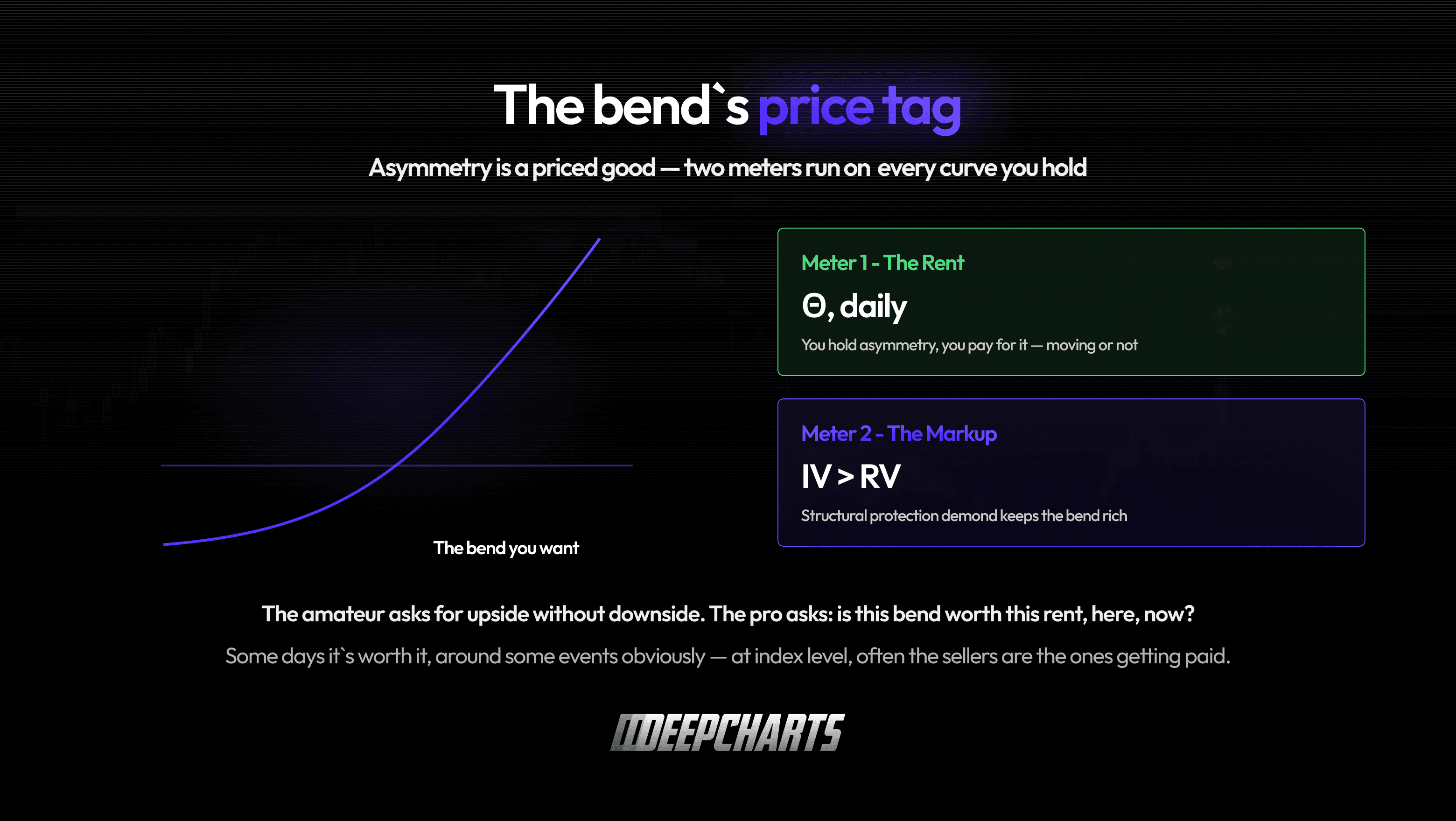
By now the series' accounting should feel inevitable. The curve is a gift with a meter attached: theta is the daily rent on the bend — you hold asymmetry, you pay for asymmetry, every day, whether it pays off or not. And as we saw last episode, that rent doesn't just cover costs: because the market's big holders structurally over-demand protection, implied volatility tends to sit above what realizes, and the bend usually trades rich. You're not renting at cost; you're renting from a landlord with pricing power.
That's not a reason to avoid convexity. It's the reason to treat it like the priced good it is. The amateur question is "how do I get upside without downside?" — the answer is you just described a long option, and it has a price tag. The professional question is "is the bend I'm buying worth the rent I'm paying, here, now?" Some days it is. Around some events it obviously is. Often, at index level, the structural premium means it isn't — which is precisely why the sellers from Episode 4 have a business.
The futures trader's version of the curve
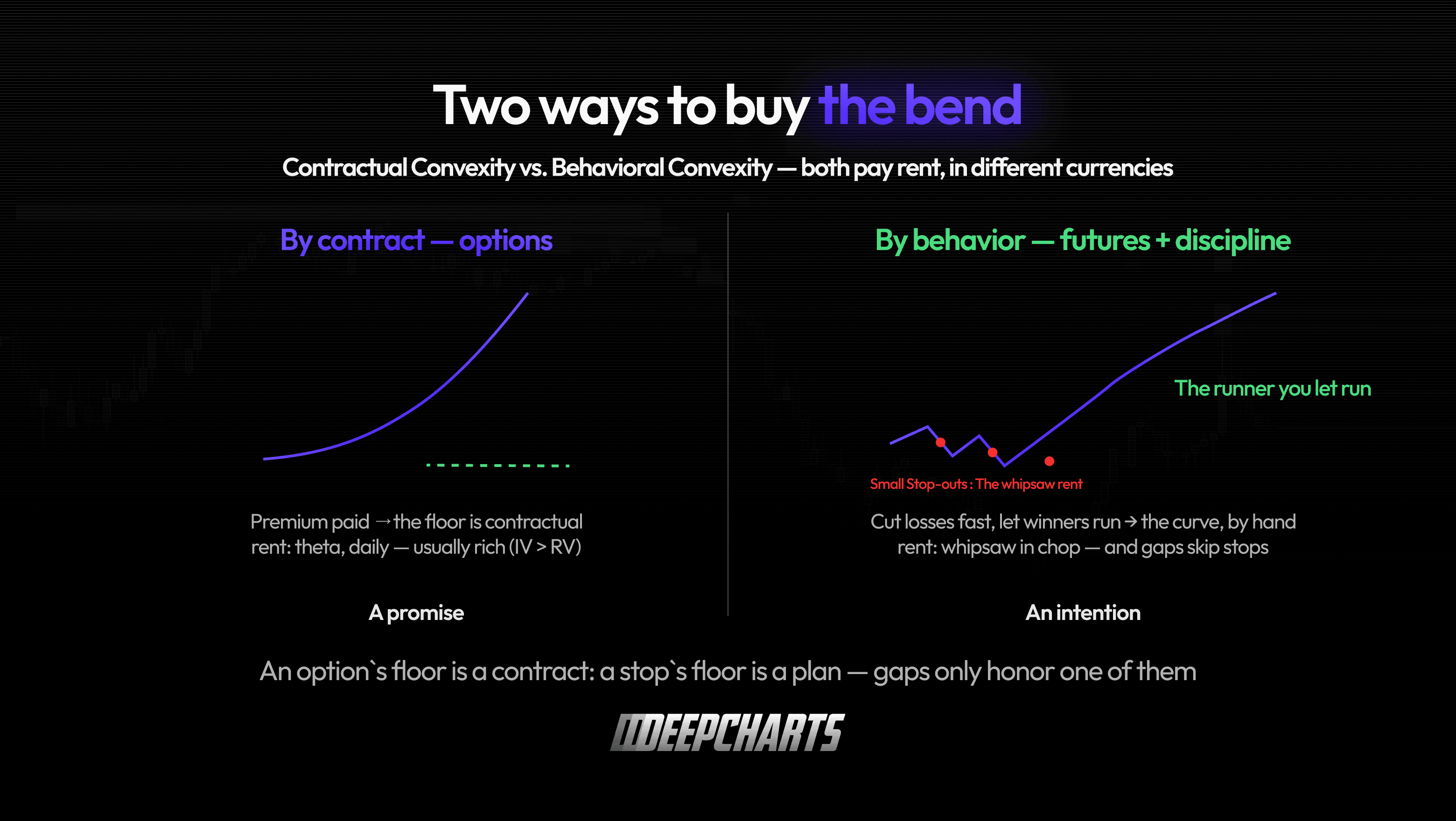
Here's the part written specifically for our readers. A futures book has zero convexity by contract. But look at what every serious futures trader is taught to do: cut losses fast, let winners run. Look at the shape of that instruction. Losses capped small, gains allowed to grow — a floor under you, open sky above. It's the curve, rebuilt by hand.
That's not a coincidence; it's the whole point. Disciplined stop-and-run trading is behavioral convexity: manufacturing with behavior what an option buys by contract. And because nothing bends for free, it has a rent too — you just pay it in a different currency. The option buyer pays theta; the futures trader pays whipsaw: all those small stop-outs in chop, the re-entries, the death by a thousand honest cuts while the market decides. Quiet, rangy markets are where behavioral convexity bleeds — the exact conditions where option sellers get paid. Same trade, mirrored.
One honest asymmetry between the two, and it matters: an option's floor is contractual; a stop's floor is an intention. Stops are path-dependent — a gap through your level fills you where the market reopens, not where you planned. The premium buyer paid extra partly for the difference between a promise and a plan. Knowing which one you're holding, and when the difference is likely to matter, is real risk literacy.
The market's net bend
Zoom out from your book to everyone's, and convexity becomes a lens for reading whole sessions — you already own most of this from Episode 3, so we'll be brief.
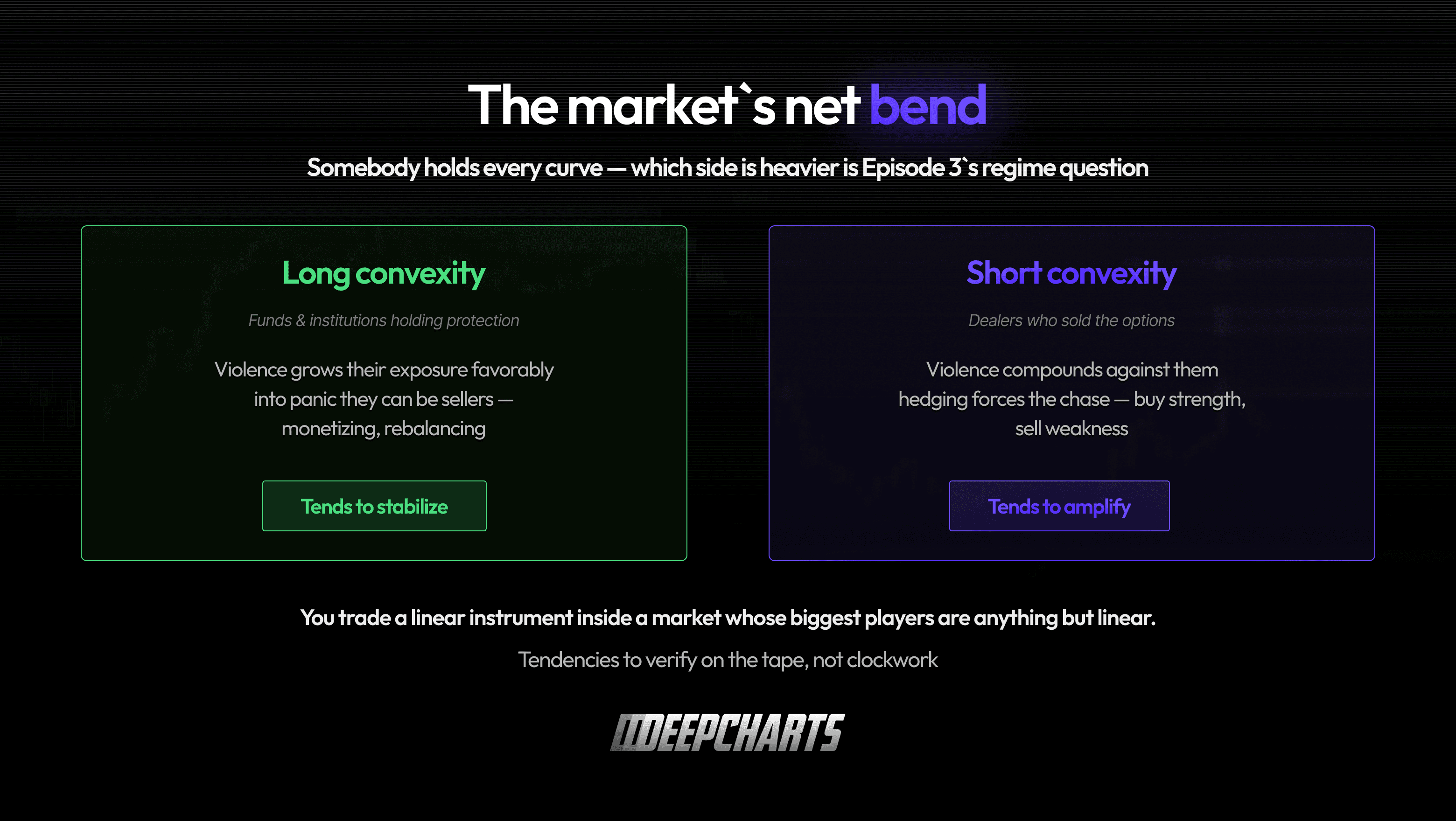
Somebody holds every curve. The funds and institutions long protection are long convexity: violence makes their exposure grow favorably, so into a panic they're often sellers of what everyone else is desperate to sell less of — monetizing, rebalancing. A stabilizing presence, tendentially. The dealers short those options are short convexity: moves force them to chase — buying strength, selling weakness — amplifying, tendentially. Which side is heavier, where, is the regime question from Episode 3, and the honest verbs still apply: these are pressures to verify on the tape, not clockwork.
The one-sentence takeaway for a futures trader: you trade a linear instrument inside a market whose biggest players are anything but linear. Their curves — who owns them, who owes them, where they kink — shape the tape you read every morning. The next episodes give you the tools for the last piece of that sentence: vega, and then the strike-by-strike maps where all the curves pile up.
FAQ
What is convexity in trading, in simple terms?
A payoff that bends in your favor: gains accelerate as the market moves your way, losses decelerate as it moves against you. Long options are convex; futures are linear — same P&L per point in both directions.
Is convexity the same as gamma?
Same phenomenon, different zoom. Gamma measures the bend of the value curve at one point; convexity is the property of the whole payoff shape. "Long gamma" and "long convexity" describe the same position.
Why do convex payoffs cost money?
Because asymmetry is valuable and the market prices it: you pay theta daily for holding the bend, and — since demand for protection is structural — implied volatility tends to sit above realized, making the bend trade rich rather than at fair cost.
Do futures have convexity?
Not contractually — delta is always 1 per contract. Traders rebuild convexity behaviorally by cutting losses and letting winners run. It works, but it pays rent in whipsaw rather than premium, and a stop's floor is an intention, not a contract: gaps don't honor it.
What does "short convexity" mean?
Being on the other side of the curve: collecting premium in exchange for a payoff where losses accelerate — being wrong compounds. Short-convexity positions profit in calm and must be actively managed in storms; at market scale, their forced hedging tends to amplify moves.
Episode 6: vega — the dial that prices the whole curve, and what happens to it when everyone reaches for insurance at once.
Deepcharts Team
·
Share this on
