

Delta, gamma, theta, vega — you’ve seen the letters, maybe skipped the chapter. Here’s the plain-English version: what each Greek measures, what it tells you, and why these numbers matter even if you never trade a single option — because they end up moving the futures you do trade.

Five numbers, one dashboard
An option’s price looks like one number, but it’s a moving target: it reacts to where the underlying goes, to how fast the clock runs, to how nervous the market is. The option Greeks are simply the gauges on that dashboard. Each one answers a single question about the same position:
Delta — if the underlying moves one point, how much does my option move? Gamma — and how fast does that answer itself change? Theta — what does one day of waiting cost me? Vega — what happens if the market’s expectation of movement shifts? Rho — and if interest rates move? Five letters, five sensitivities. Nothing more mysterious than that.
Two things are worth fixing in your head before we go one by one. First: the Greeks describe the option’s price, not the market’s direction — they are risk measures, not signals. Second: they are model outputs, not observed facts. A pricing model and a volatility surface produce them, which is why two platforms can show slightly different numbers for the same contract. Keep that honesty in your pocket; it will matter at the end.
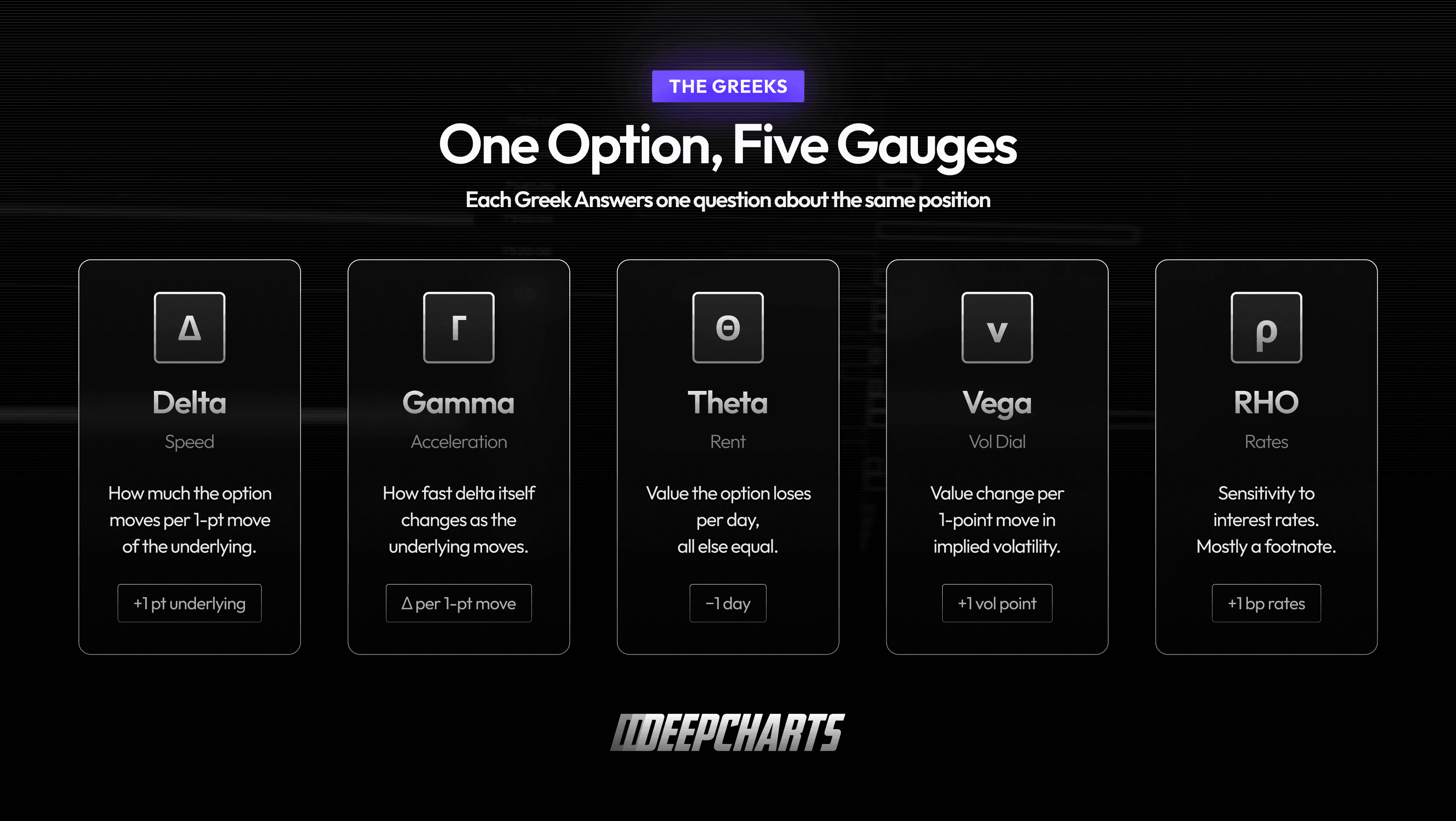
Figure 1 · One option, five gauges
Delta: the speed
Delta tells you how much the option’s price moves for a one-point move in the underlying. A call with a 0.50 delta gains about half a point when the index gains a point. A put with a −0.30 delta gains 0.30 when the index drops one.
Delta runs from 0 to 1 for calls (0 to −1 for puts), and it doubles as a rough map of moneyness: far out-of-the-money options sit near 0, at-the-money options sit near 0.50, deep in-the-money options approach 1 — at which point the option basically is the underlying.
There’s a second reading, and it’s the one professionals actually use: delta is equivalent exposure. Holding a 0.50-delta call on the S&P 500 is, for small moves, like holding half a unit of the index. That translation — from option position to “index units” — is the bridge between the options world and the futures world, and we’ll cross it properly in a minute.
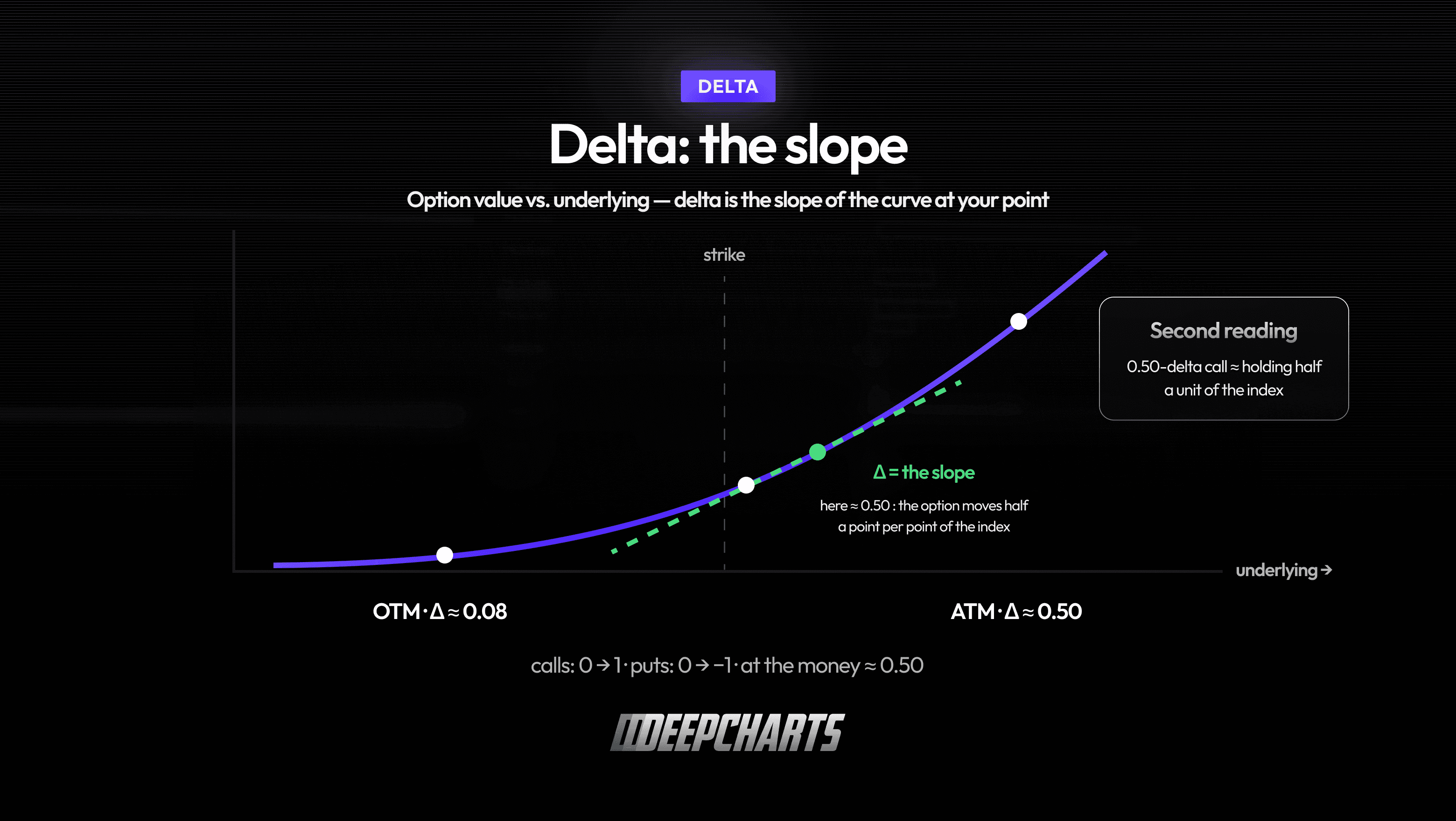
Figure 2 · Delta
Gamma: the acceleration
Here’s the catch: delta doesn’t sit still. As the underlying rises, a call’s delta climbs; as it falls, the delta slides back down. Gamma measures how fast delta changes per one-point move in the underlying. If delta is speed, gamma is acceleration.
Gamma is at its maximum where the outcome is most uncertain: at the money, close to expiration. A far-dated option’s delta drifts; a same-day at-the-money option’s delta can swing violently — from “probably worthless” to “practically stock” — within a single session. That’s why 0DTE options are, in a real sense, pure gamma.
Why should you care about the second derivative of anything? Because gamma is the reason option positions have to be managed, not just held. Whoever is short options must keep adjusting their hedge as delta moves — and those adjustments are real orders in the market.
Gamma is the Greek that generates flow. It’s the one this blog has already spent an entire article on, and we’ll link it below.
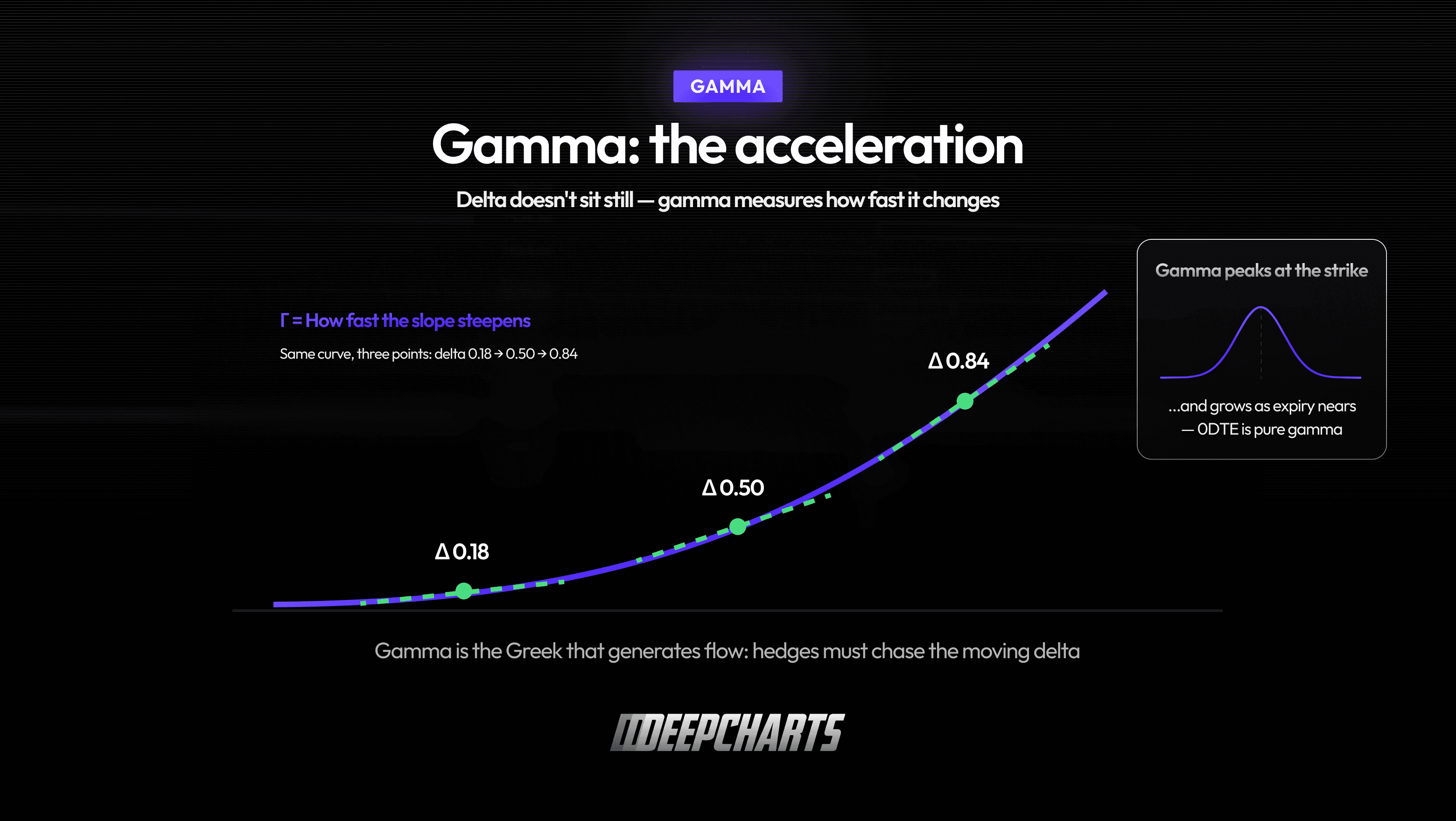
Figure 3 · Gamma
Theta: the rent
Options expire, and the possibility they sell is worth less with every day that passes. Theta tells you how much value an option loses per day, everything else unchanged. If your call has a theta of −0.45, tomorrow it’s worth about 0.45 points less than today even if the index doesn’t move at all.
Theta is the rent the buyer pays for the right to be long possibility — and the income the seller collects for carrying the risk. It isn’t linear: decay is polite while expiration is far away and accelerates sharply into the final days, which is exactly when gamma is exploding too. That’s not a coincidence; theta is, loosely, the price of the gamma you hold. Long options: you own acceleration and pay rent daily. Short options: you collect rent and owe acceleration. There is no configuration that gives you both.
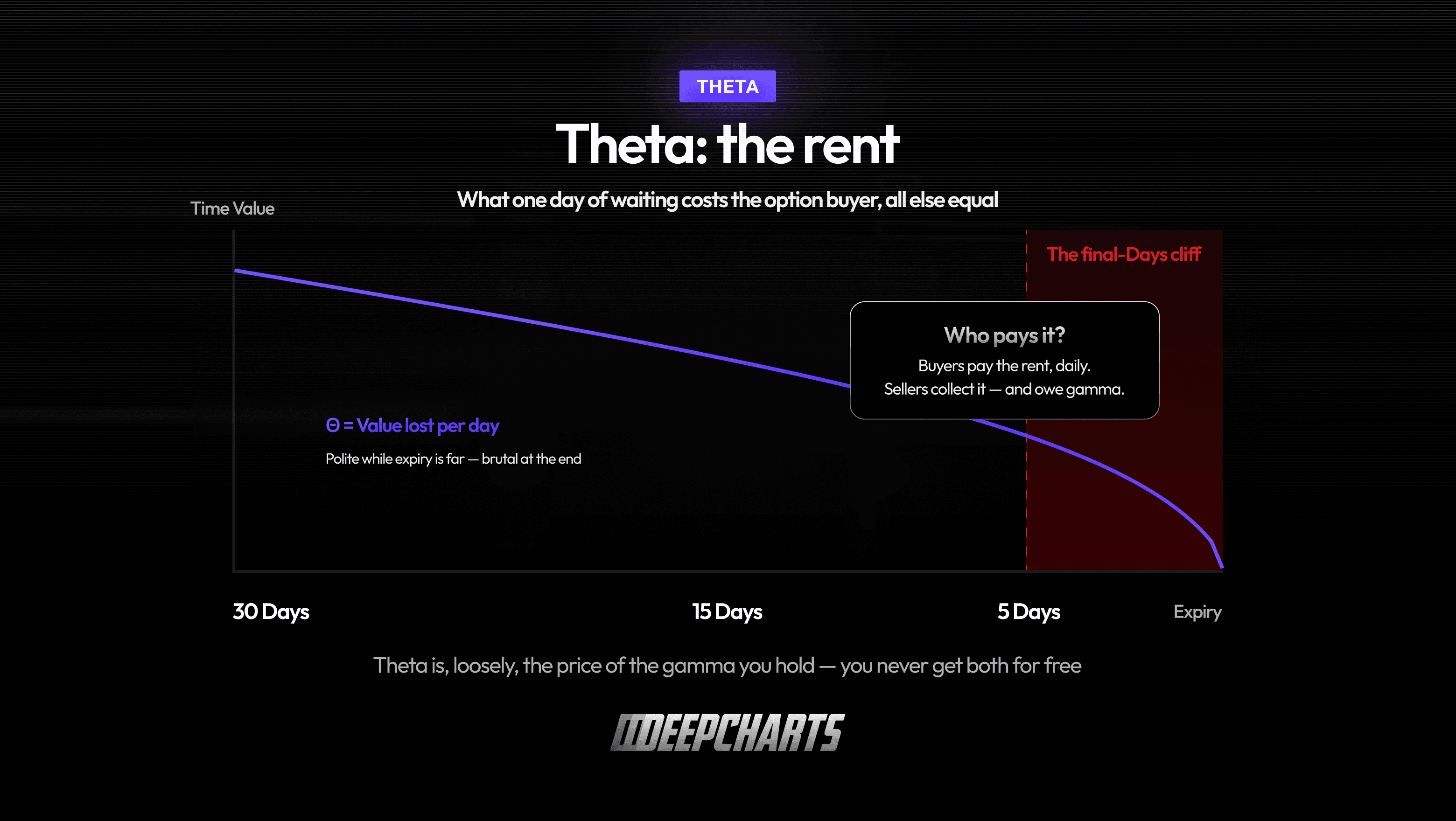
Figure 4 · Theta
Vega: the volatility dial
The last big input isn’t price or time — it’s expectation. Options are priced off implied volatility (IV): how much movement the market expects from the underlying between now and expiration. Vega tells you how much the option’s value changes when IV moves one percentage point.
This is the Greek that explains the classic beginner heartbreak: you buy a call before earnings, the stock gaps up, and the call barely moves — because implied volatility collapsed the moment the uncertainty resolved. The direction was right; the vega was wrong. Price moved for you, the volatility dial turned against you, and the two roughly canceled.
Vega is largest for at-the-money options with plenty of time left, and it’s the reason “cheap” and “expensive” in options are statements about IV, not about the dollar premium.
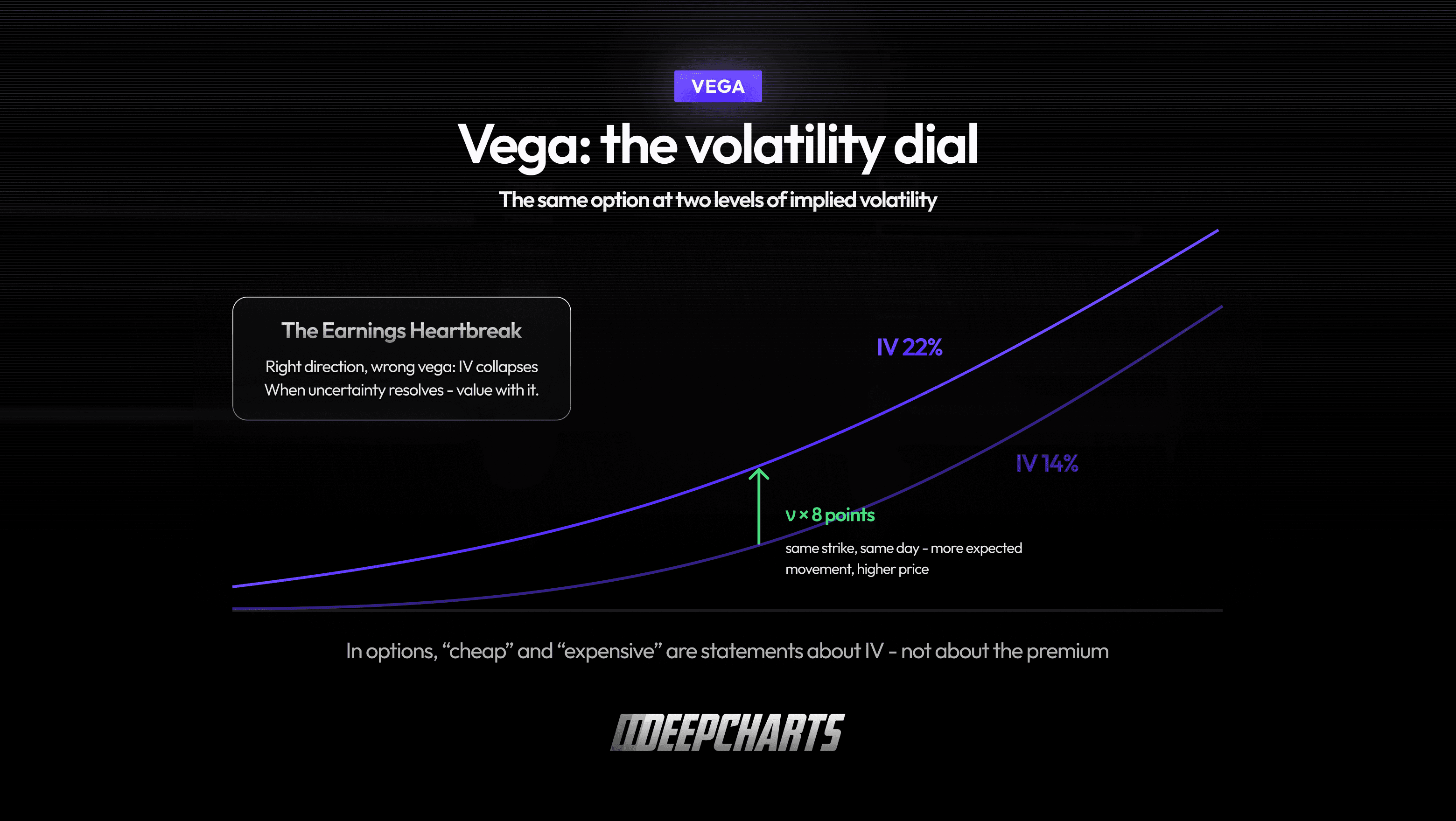
Figure 5 · Vega
Rho: the one nobody watches (until they do)
For completeness: rho measures sensitivity to interest rates. For short-dated index options it’s a rounding error, which is why nobody talks about it; for long-dated options in a fast-moving rate environment it quietly matters. File it, and move on.
Where the numbers come from (an honest note)
One thing separates a trader who uses Greeks well from one who gets used by them: knowing what kind of number they are. A delta is not printed on the exchange tape. It comes out of a pricing model fed with a volatility surface — change the model’s assumptions and the number shifts. Greeks are modeled, not observed: excellent instruments, not facts of nature. It’s the same discipline we apply across our own tooling — we wrote down exactly what in our data is observed, what is reconstructed and what is modeled, in our methodology page — and it’s the right lens for every Greek you’ll ever read, on any platform.
Why futures traders should care
Fair question: if you trade ES or NQ and never touch options, why learn any of this?
Because the Greeks don’t stay in the options market. The dealers on the other side of the world’s option flow — the market makers selling protection to funds and 0DTE lottery tickets to retail — do not want directional risk. They neutralize it by trading futures: delta tells them exactly how many contracts their book requires, and gamma tells them how violently that requirement changes as price moves. When their books force them to re-hedge, the orders land on the same tape you’re reading. Sooner or later, the book forces the adjustment; the direction of it is not a choice.
That has a practical consequence: aggregate dealer positioning — measured in Greeks — is one of the few things in a market that can be estimated in advance, because it’s driven by obligation rather than opinion. Where that estimated hedging pressure concentrates, you get a map of levels worth watching on the futures: a hypothesis with an address, to verify on the tape. That map is what Gamma Exposure (GEX) is, it’s what our DeepGamma toolkit builds from exchange-reported options data, and it’s the subject of the full breakdown we published here on the blog.
So no — you don’t need to trade options. But the Greeks are the accounting system of the players who must trade your futures. Learning to read them is learning to see one more layer of the tape.
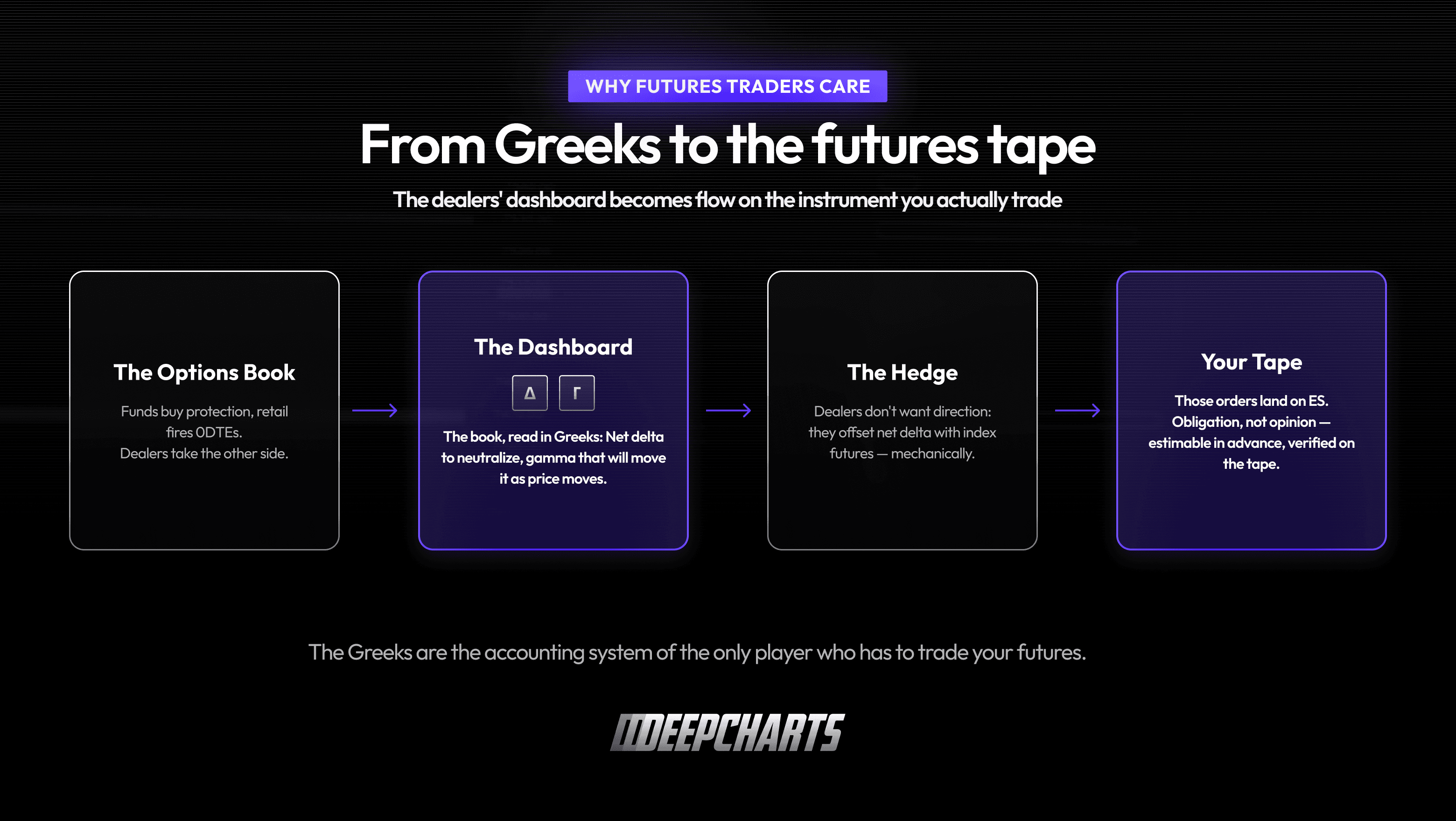
Figure 6 · From Greeks to the futures tape
What’s next in this series
This was the map; the territory comes next. In the following articles we’ll take the Greeks one at a time — delta and what it really means to be “synthetically long”, gamma and the two market regimes it creates, theta and who actually earns it — each one from the same angle: the basic concept, and what it changes for a futures trader.
FAQ
What are the option Greeks in simple terms?
They’re the sensitivities of an option’s price: delta (to the underlying’s moves), gamma (how fast delta changes), theta (to the passage of time), vega (to implied volatility), rho (to interest rates). Five gauges on one dashboard.
Which Greek is the most important for beginners?
Start with delta — it’s the most intuitive (how much your option moves) and it doubles as your effective exposure. Then gamma, because it explains why delta won’t stay put — and why option flows spill into the futures market.
What’s the difference between delta and gamma?
Delta is the option’s speed relative to the underlying; gamma is its acceleration — how much delta itself changes per one-point move. A 0.50-delta, high-gamma option behaves very differently from a 0.50-delta, low-gamma one.
Do option Greeks affect futures prices?
The Greeks themselves don’t move anything — but dealers hedging the exposures the Greeks describe trade index futures in size, mechanically, every session. Mapping that estimated flow is what Gamma Exposure analysis does; whether it shows up at a given level is a hypothesis you verify on the tape.
Are the Greeks exact numbers?
No. They’re outputs of a pricing model and a volatility surface, which is why they differ slightly across platforms. Treat them as high-quality instruments, not observed facts.
The Greeks are the grammar of the options market. Next up: reading its sentences, one letter at a time — starting with delta.
Deepcharts Team
·
Share this on
