



On July 27, CME Group put futures on more than 50 of the biggest U.S. stocks — Nvidia, Tesla, Apple, SpaceX — trading nearly 23 hours a day. This is not just a new product. It’s single names arriving on futures infrastructure, and for anyone who reads order flow, it changes what you can actually see.

A product with a history
Single-stock futures have been tried in America before. OneChicago listed them for almost two decades and shut down in 2020, starved of volume. The product wasn’t wrong — the plumbing was. A regulatory compromise dating back to the early eighties split oversight between two agencies, which meant margins never got competitive with either options or plain stock. Delivery mechanics were clunky. And the retail rails that move today’s futures markets — micro contracts, app-native brokers, around-the-clock risk desks — simply didn’t exist.
So the market shrugged, volume never compounded, and for six years “single-stock futures” was a phrase you only heard in market-structure trivia. That’s the right lens for what just happened: the second attempt is not a copy of the first. Almost every variable that killed the product in its first life has been changed on purpose.
What went live, precisely
On July 27, 2026, CME launched Single Stock futures on 50+ leading U.S. names — Nvidia, Tesla, Apple, Amazon, Meta, Alphabet, Palantir, AMD, Micron and, following its listing, SpaceX. Seventy-seven contracts in total: 55 standard-sized (100 shares each) and 22 Micros (10 shares), with the list expected to grow with demand.
The design choices matter. The contracts are cash-settled — no delivery, no assignment, no shares moving anywhere. They list quarterly expirations with two months quoted at any time, tick in $0.01 per share ($1 per standard contract), and trade nearly 23 hours a day on Globex, on the same clock as ES and NQ. Margin is futures-style performance bond: buying power in the region of six times what Regulation T allows on the stock itself. Shorting requires no locate and no borrow arrangement — you just sell. And distribution was solved before launch: more than 35 retail brokers were connected at day one.
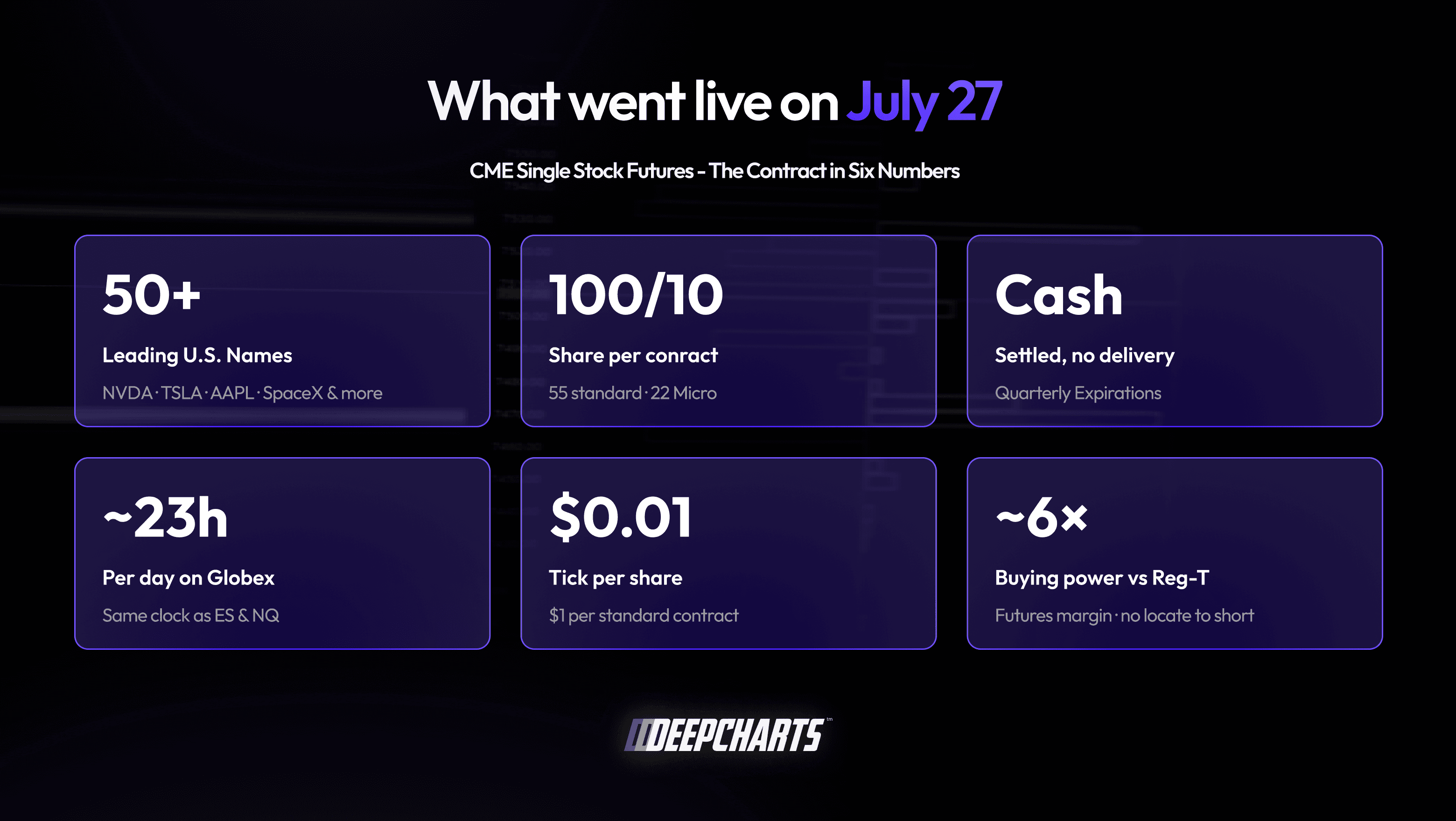
Figure 1 · What went live on July 27
Why this version can work where 2001’s failed
Run down the old failure points one by one. Split regulation? Gone — these are CFTC-regulated futures cleared at CME like any other. Uncompetitive margin? Gone — performance-bond margin is the whole point. Delivery friction? Gone — cash settlement. No retail ecosystem? The opposite: the micro-contract boom of the last six years built exactly the pipes a product like this needs, and this launch runs through them from day one.
And there’s a demand driver that didn’t exist a generation ago. Earnings land at 4:05pm; the cash session is closed until the next morning; the most interesting hours of a stock’s week now happen when the stock itself barely trades. A nearly-23-hour future on the single name means the reaction gets priced immediately, on a real order book.
None of this guarantees liquidity — young products have to earn their volume, and OneChicago is the standing reminder. But the ingredients this time look like the ones that made micro index futures explode, not the ones that starved SSFs twenty years ago.
The direction of travel: everything becomes a future
Zoom out and this launch is one move in a longer migration. Compare the two stacks honestly. Cash equities: a 6.5-hour lit session, venue fragmentation measured in the dozens, roughly half of volume executed off-exchange, T+1 settlement, Reg-T margin, and a locate requirement every time you want to be short. Futures: one central limit order book per product, central clearing, performance-bond margin, a short that is just a sell, and a session that covers nearly the whole clock.
That’s why the last decade of market-structure innovation keeps landing on the futures side: micro contracts brought retail in, crypto listed on CME before most banks would touch it, event markets grew up under the CFTC, and now the biggest single names in the world have futures of their own. The infrastructure with fewer frictions keeps absorbing more of the risk transfer.
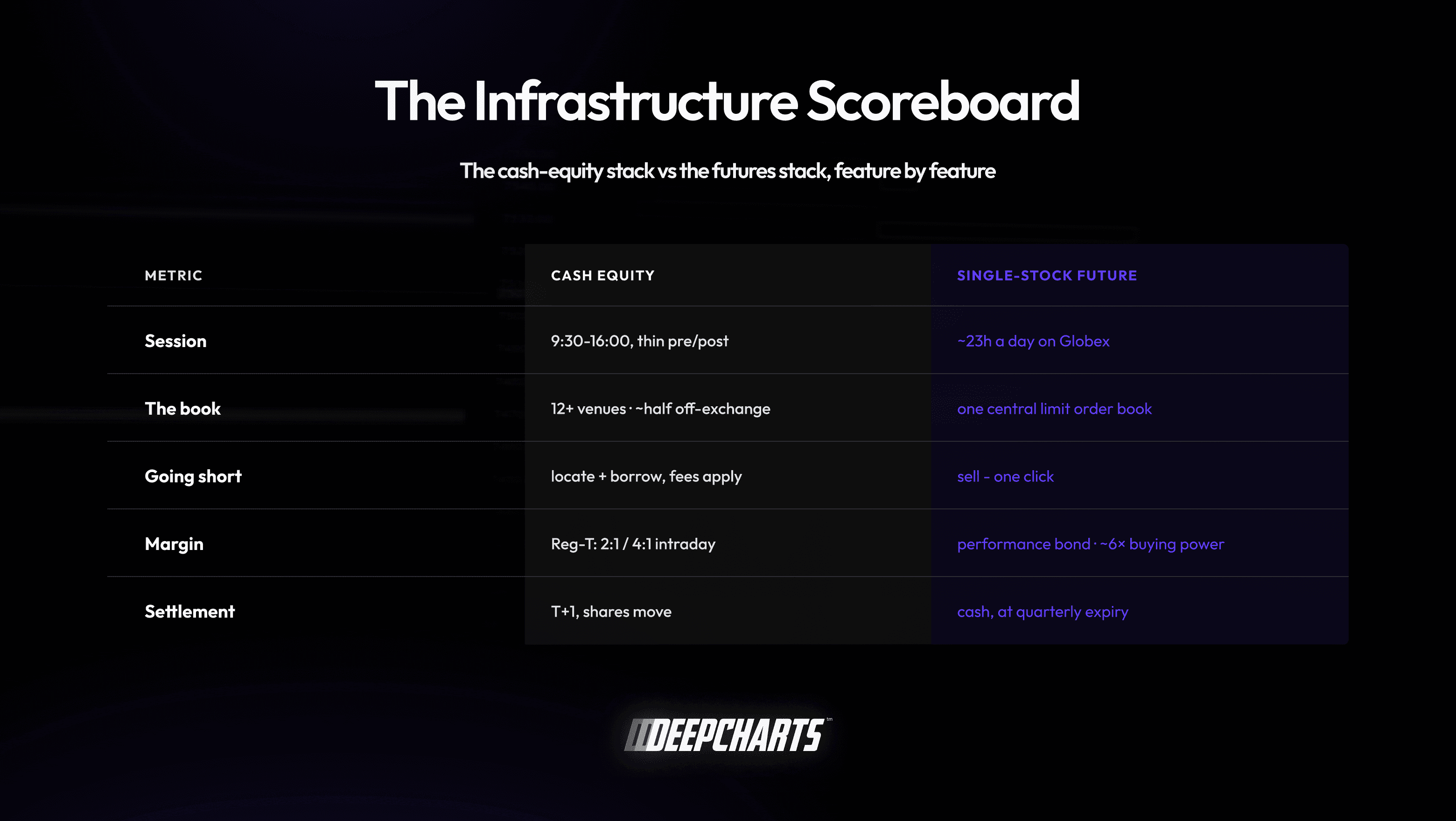
Figure 2 · The infrastructure scoreboard
How the micromechanics change
Price discovery leaves the cash clock. The index already lives on ES overnight; now the single name can too. Post-earnings, pre-open, Sunday night: the marginal price of Nvidia becomes visible on a centralized book almost around the clock, instead of being inferred from a thin pre-market tape and a stale close.
The tape becomes readable. This is the deep one. U.S. equity volume is fragmented across a dozen-plus exchanges, and roughly half of it never touches a lit exchange at all — internalized, matched off-exchange, invisible. Whatever footprint you build on a stock, you’re reading a partial print by construction. A single-stock future is the opposite: one central limit order book, on Globex, with every contract printing in one place. Depth, prints, imbalances, absorption — for the first time, single-name order flow can be read the way index traders read ES.
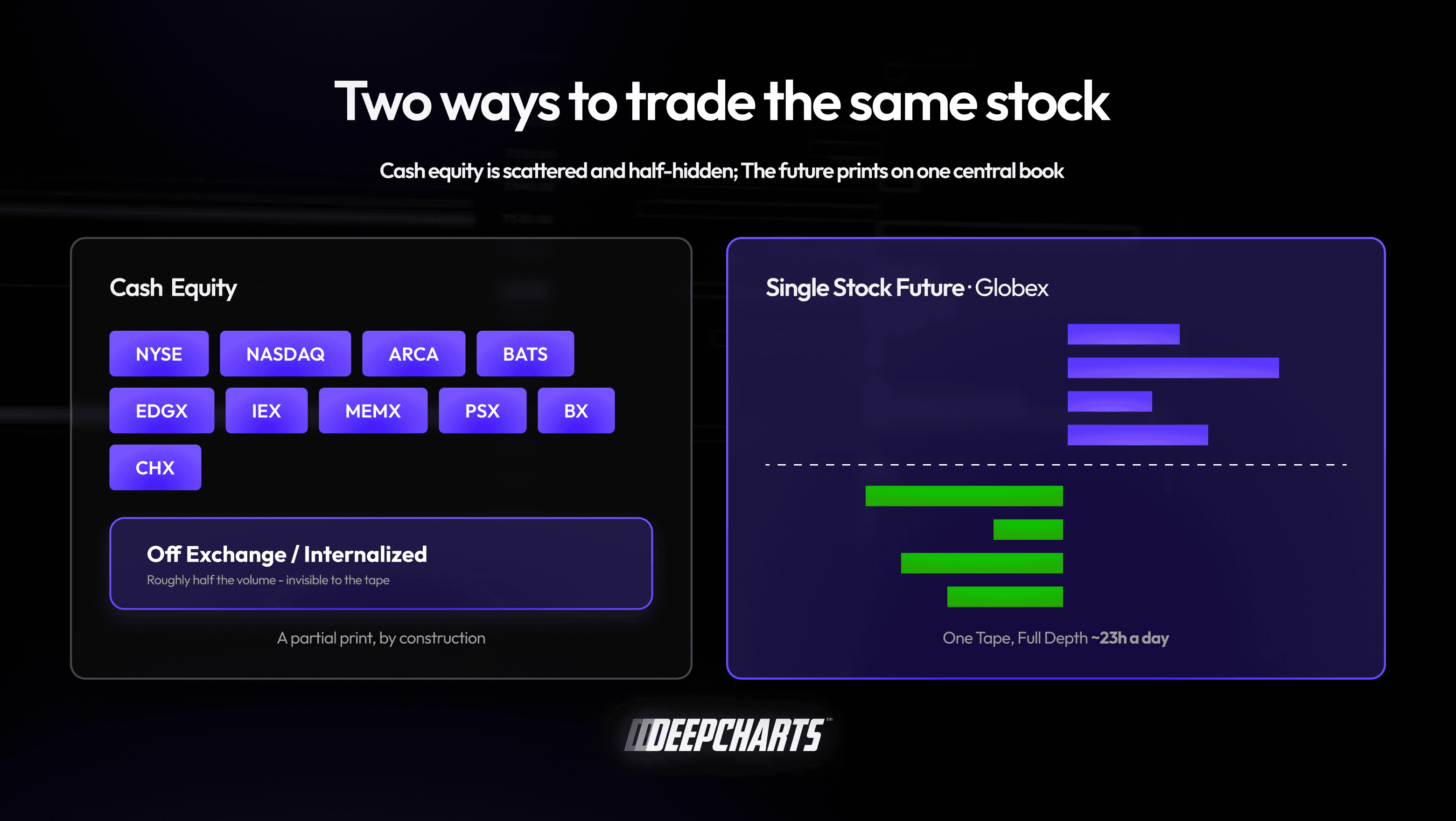
Figure 3 · Two ways to trade the same stock
Dealers get a new hedging vessel. Options market makers on single names have always hedged delta in the stock — with borrow costs, locate frictions and cash-session hours attached. The future removes all three: short delta with one click, cross-margined at CME against everything else on the book, tradable while the reaction is actually happening. As liquidity builds, the mechanical hedging flows that our readers know from the index — the whole gamma story — start printing on the single-name futures tape.

Figure 4 · The new hedging vessel
The basis starts talking. A future’s premium or discount to cash is arithmetic: financing minus expected dividends. Which means the basis is information. On a crowded, hard-to-borrow name, the future trades cheap to fair value — the discount is the borrow, printed on screen, no securities-lending terminal required. Around dividend dates, the basis tells you what the market believes about the payout. Watch it drift into a big earnings print and you’re watching positioning pressure in real time.
Expiries interact. Cash-settled quarterlies now sit alongside the same names’ monthly and weekly option expirations. Settlement marks, roll windows and single-name OPEX pinning start sharing one calendar. Anyone who has watched an index OPEX knows these interactions are where mechanical flows concentrate — and now every big name gets its own version.
Earnings night, replayed
Put it together with a concrete scenario. Nvidia reports at 4:20pm. The cash market closed twenty minutes ago; under the old structure, the next four hours belong to a thin, fragmented after-hours tape that most tools can’t even chart properly, and price discovery restarts — noisily — at 9:30 the next morning.
Now: the number hits, and within seconds the Nvidia future reprices on a central book with visible depth. You watch the first impulse, the absorption at the new level, the failed retest — the standard footprint read, except it’s 4:23pm and the instrument is a single name. By the time the cash market opens the next day, the discovery has already happened, in public, on one tape. The open stops being a mystery and becomes a level you’ve already seen defended.
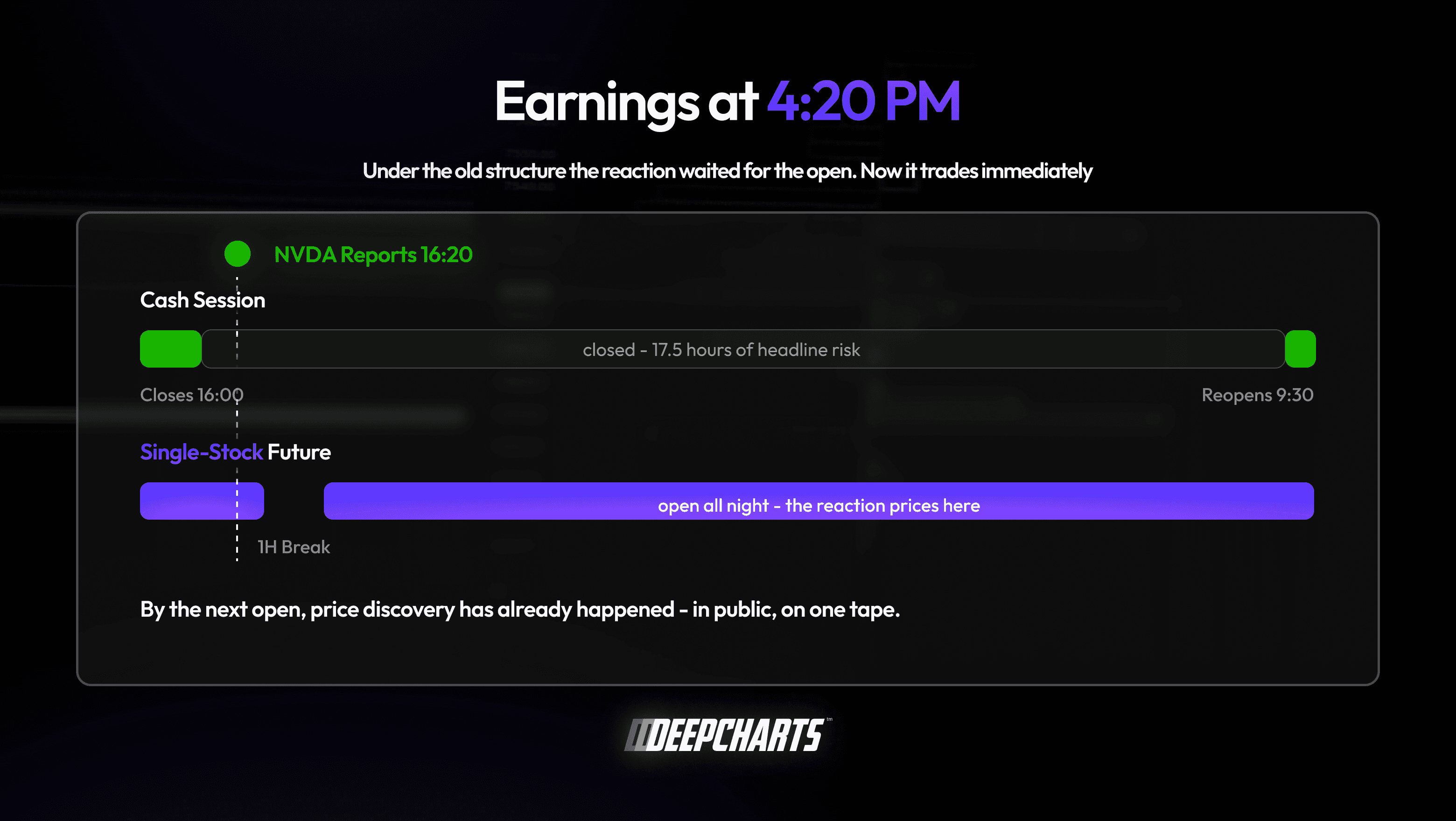
Figure 5 · Earnings at 4:20pm
The first weeks: what to actually watch
A new contract is a promise until the volume shows up, so treat the early tape as an object of study. Watch which names lead — liquidity will not arrive evenly, and the mega-caps will make a market first. Compare spreads and depth to the underlying stock through the cash session, then watch what remains after the close: the overnight book is where this product either earns its keep or doesn’t. Track the basis around dividends and earnings — early mispricings are where the education (and the opportunity) lives. And respect the risk: a leveraged single name can gap double digits on a headline; futures margin cuts both ways. Hard stops, defined risk, and a calendar with every earnings date on it.
Where deepcharts stands
This is the part we care about. deepcharts was built futures-native: when a new product lands on Globex, it isn’t a new module or a roadmap item — it’s a new symbol.
That means the entire toolkit applies to single-stock futures from day one. The footprint reads the new tape exactly as it reads ES. The DOM shows the book as liquidity builds. Volume profiles map the levels the overnight session creates. Deep Pattern Builder lets you define conditions on the new symbols and start measuring their behavior — quantitatively, from the first weeks of data — instead of guessing how a young contract trades. Replay lets you re-run the earnings night the morning after. And the premium data infrastructure underneath — dxFeed, Rithmic — carries CME products by construction, so there is nothing to wait for.
As the single-name derivatives stack matures, the DeepGamma approach — regime plus key levels, built from real options data — extends naturally from the index to the names. The direction of travel is clear, and it points at futures infrastructure.
When market structure moves, a futures-native platform moves with it — day one.
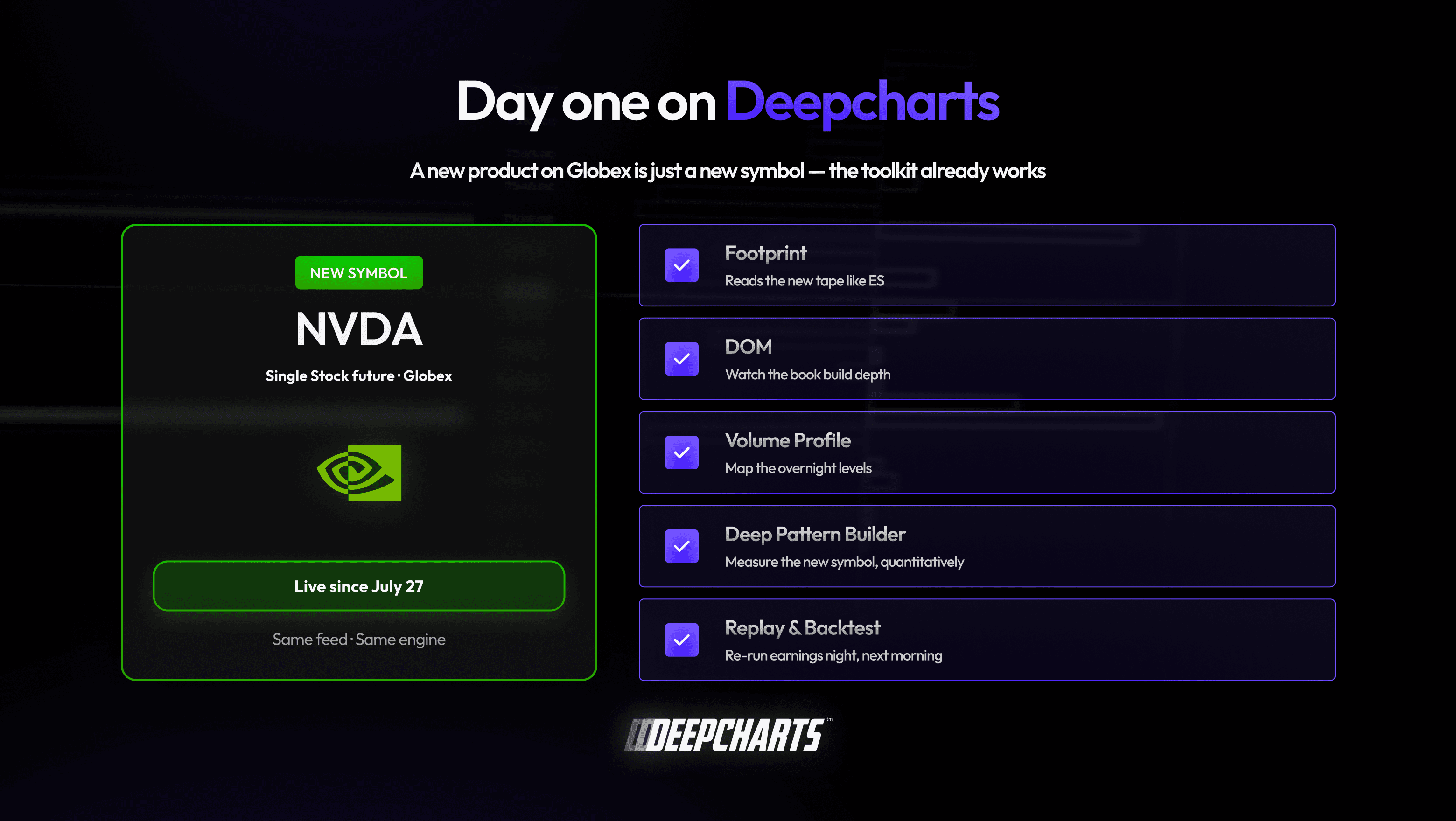
Figure 6 · Day one on deepcharts
The single-name tape used to be something you inferred. Now it’s something you read.
Deepcharts Team
·
Share this on
