



Nine episodes of parts, laid out on the workbench: delta, gamma, theta, vega, the quiet Greeks, the maps and their honest limits. In this finale we assemble the machine and switch it on — a full week inside a dealer’s book, trade by trade, so you can see exactly how the discipline works, where its P&L actually comes from, and why, once you’ve watched it run, you’ll never look at your futures tape the same way again. Episode 10 of our Greeks series: the last one.
The mandate
Every piece of this series traces back to one job description. The dealer — the market maker on the other side of the world’s option flow — sells optionality for a living. It collects the rent (Episode 4), it warehouses the tail, and it has exactly one non-negotiable rule: no directional bets. Its edge is the premium, priced rich by structural demand (Episode 4 again — the volatility risk premium). A directional opinion would put that entire business model at the mercy of a coin flip. So the mandate is brutally simple:
Keep the book’s delta at approximately zero. Always. Whatever it takes.
“Dynamic delta hedging” is the procedure that enforces the mandate. Delta hedging because the thing being neutralized is the book’s net delta (Episode 2) — its real, additive exposure in index units. Dynamic because, as this series has documented from three different directions, delta refuses to sit still: price moves it (gamma, Episode 3), time moves it (charm), volatility moves it (vanna — both in Episode 7). A hedge set once is a hedge already going stale. The mandate therefore isn’t a trade; it’s a loop.
The loop
Here is the whole machine, four steps, running from open to close and through most of the night:
Measure the book’s net delta — thousands of positions, one number (Episode 2). Compare it to the target: zero. Check the band: is the gap inside tolerance? If yes — do nothing. If no — trade futures to bring it back, and go back to step one.
The band is the underrated genius of the whole system, and it answers an objection sharp readers raised back in Episode 3: surely they don’t re-hedge every tick? They don’t. Hedging every tick would bleed the desk dry in transaction costs — crossing the spread hundreds of times a day to chase noise. Hedging too rarely is worse in the other direction: the gap between book and hedge is unmanaged exposure, and gamma grows it fast exactly when markets move fast. So desks define a tolerance band around zero — sized to their risk appetite, the day’s volatility, the cost of trading — and act only at the edges. Inside the band: patience. At the edge: no discretion, no opinion, execute.
That one design choice explains something you’ve felt on the tape without naming it: mechanical flow arrives in pulses, not as a continuous drizzle. Nothing, nothing, nothing — then a band edge somewhere gets hit, and size shows up.
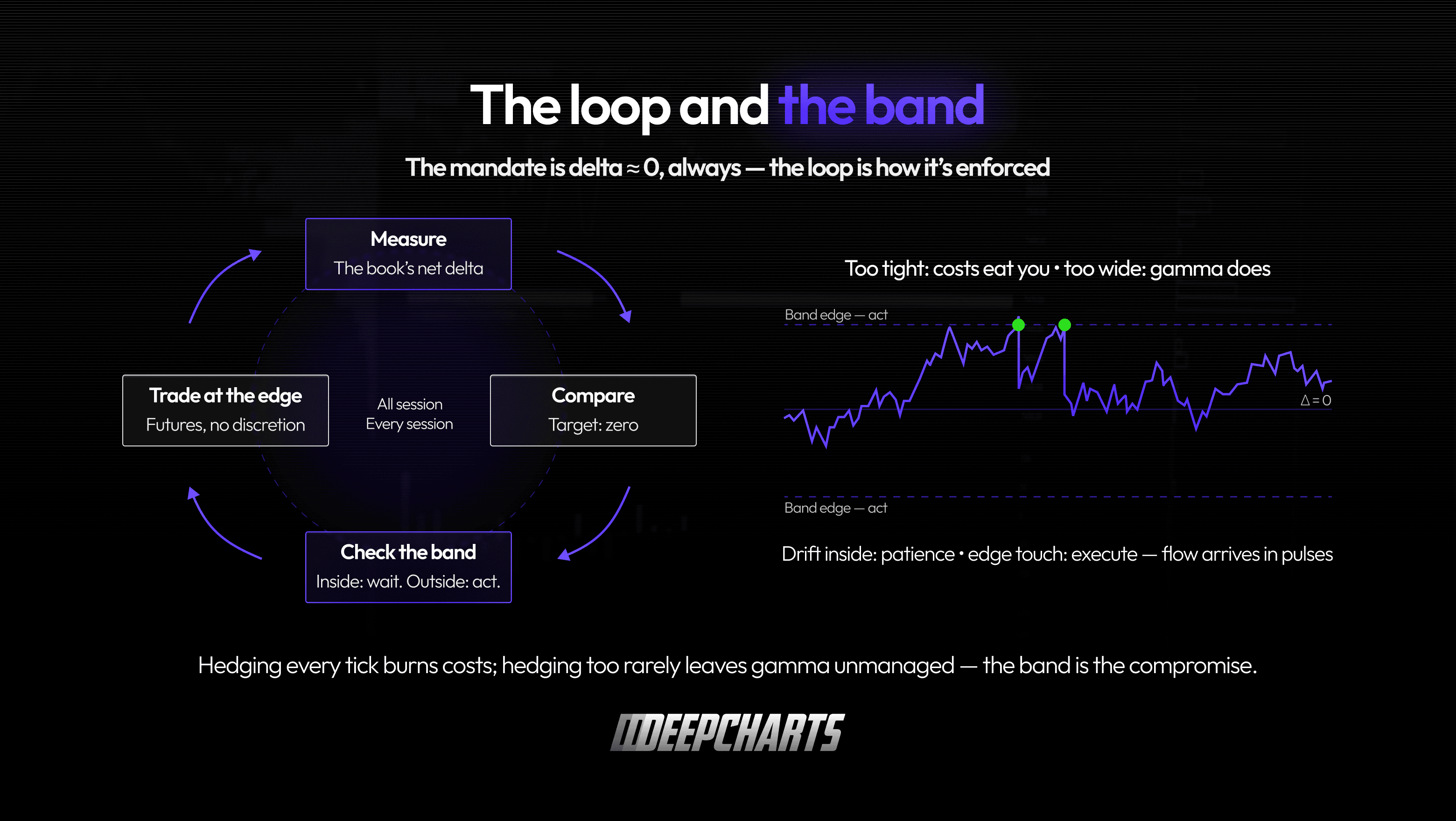
Figure 1 · The loop and the band
A week inside the book
Time to run the machine with real numbers. Keep the book deliberately simple — the arithmetic scales, the logic doesn’t change. Monday morning: a fund buys 500 calls on the index, strike 6,000, delta 0.50, expiring Friday. Our dealer sells them, collecting the premium — say 40 points per contract, roughly 2.0 million in rent for the week, priced off an implied vol the desk knows is a touch rich (Episode 6).
Monday, 10:02. Being short 500 calls at 0.50 delta is being short 25,000 index units (500 × 100 × 0.50 — Episode 2’s translation). The mandate says flat, so the desk buys 500 ES (≈50 units each). Book delta: ~0. Band: quiet. Coffee.
Tuesday. The index rallies 25 points. Gamma does what gamma does (Episode 3): the calls’ delta climbs to 0.58, the option book is now short 29,000 units against a 25,000 hedge — 4,000 adrift, outside the band. Execute: buy 80 more ES. Notice the direction and the price: the desk is buying after a rally — buying high, by construction, with no view and no choice. Overnight, theta ticked its first payments into the book (Episode 4): the rent has started arriving.
Wednesday. A trap of a day: the market pops 15 in the morning (band edge — buy 30 ES near the high), then gives it all back by the close (band edge again — sell ~30 ES near the low). Price went nowhere; the desk demonstrably lost money trading — bought high, sold low, twice crossed the spread. This is not incompetence. This is the product working as designed, and we’ll price it properly in a moment. Meanwhile theta collected its biggest day yet — mid-week, at the money, the meter runs fast.
Thursday. Quieter tape, drifting slightly lower, and the calm itself does work: implied vol softens two points and another day burns off. Vanna and charm — the quiet Greeks of Episode 7 — both shrink the calls’ delta without price doing anything dramatic. The 25,000-unit hedge is now oversized against a book that’s only short ~20,000: band edge, from the inside. Sell ~100 ES into a drifting market. Anyone watching the tape sees unexplained supply on a newsless afternoon. You know exactly what it is.
Friday, 4:00pm. The index closes at 5,995 — below the strike. The calls expire worthless: delta collapses to zero through the afternoon (charm’s endgame), the desk unwinds the last of the hedge, and the ledger closes. Rent collected in full: 2.0 million. Paid out along the way: the Tuesday chase, the Wednesday round trip, Thursday’s unwind, a week of spreads and fees — the movement bill. The week’s profit is what’s left of the rent after the market’s actual movement was paid for.
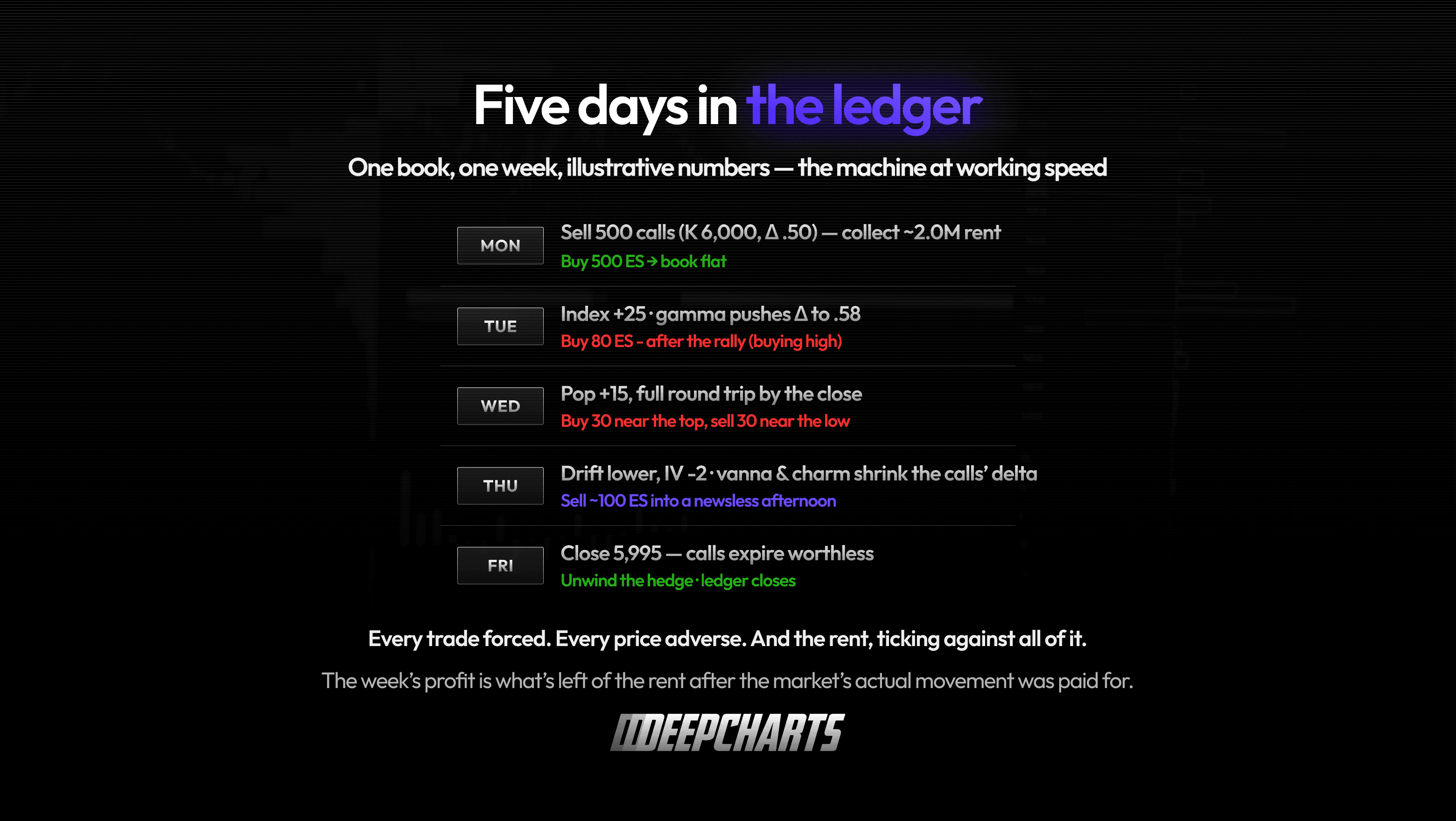
Figure 2 · Five days in the ledger
The engine: where the P&L actually lives
Look at the shape of what just happened, because it’s the deepest single idea in this series.
Every re-hedge the short-gamma desk executed traded with the market: bought after rallies, sold after breaks. Run enough cycles and that systematically adverse trading sums to a bill proportional to how much the market actually moved — the desk pays for realized movement. Against it stands the rent: theta, collected daily, which is nothing but the market’s priced expectation of movement, amortized (Episodes 4 and 6).
So the hedged option book reduces to one clean confrontation: rent in, round-trips out — implied movement collected, realized movement paid. The market moves less than was priced: the rent covers the bill, the desk keeps the difference. It moves more: the bill exceeds the rent, and the desk finances everyone else’s convexity out of pocket. The dealer’s whole P&L is the gap between expected and delivered movement — which is why the volatility risk premium of Episode 4 isn’t an abstraction. Dynamic hedging is the machine that converts IV-minus-RV from a chart into a paycheck — or a casualty report.
And one elegant symmetry, for the road: the long-gamma trader on the other side runs the same loop with every sign flipped — re-hedges sell rallies and buy dips (trading against the market, pleasantly), pays the rent daily, and profits precisely when movement beats what was priced. Two disciplined machines, opposite seats, and between them they manufacture most of what this series has called mechanical flow.

Figure 3 · Rent vs. round-trips
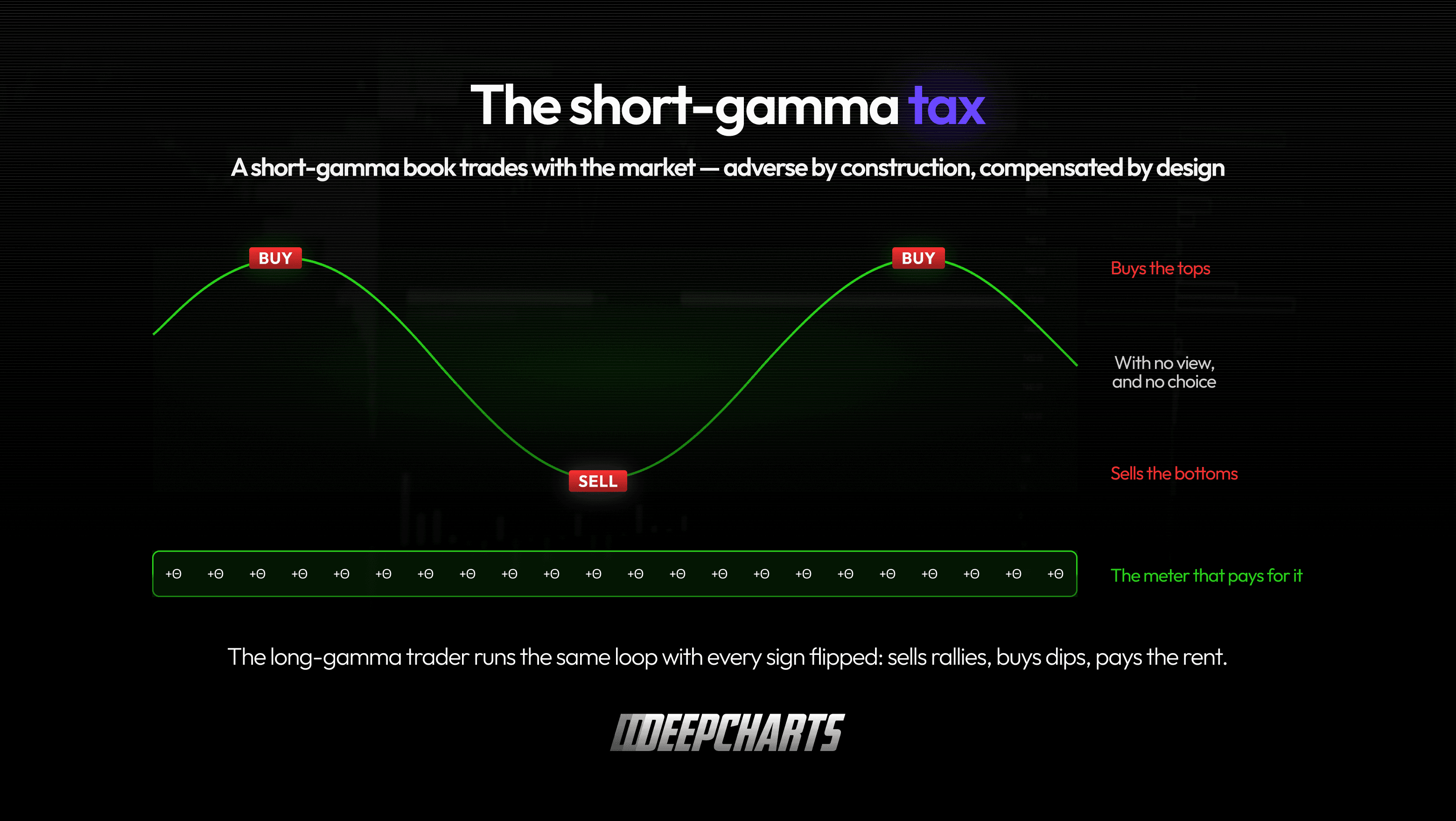
Figure 4 · The short-gamma tax
The machine on your tape
Now step back onto your side of the screen, because this section is the reason a futures platform wrote ten episodes about options.
Every turn of the loop prints on the futures tape — and you now own every dial that governs it. The direction of the forced flow is set by the seat: aggregate short gamma trades with the market, long gamma against it (Episode 3). The size is set by gamma — largest near big strikes, into expiries, on 0DTE. The triggers are the three clocks of Episode 7: price, calendar, and vol, two of which run while the market stands still. The addresses are the concentrations of Episode 8 — walls, where band edges cluster because exposure does. And the regime — which direction the whole machine leans — flips across the estimated border of Episode 9.
That’s the series, assembled: who must trade, how much, when, where, and which way. None of it tells you where the index closes on Friday — the oldest disclaimer in this series, and it holds to the end. What it gives you is stranger and more useful: on a tape full of opinions, you can now pick out the one participant who doesn’t have one. The steady bid under a quiet drift. The supply that arrives at the same strike every time. The seller who shows up because it’s falling. Once you’ve seen the machine run, you can’t unsee it.
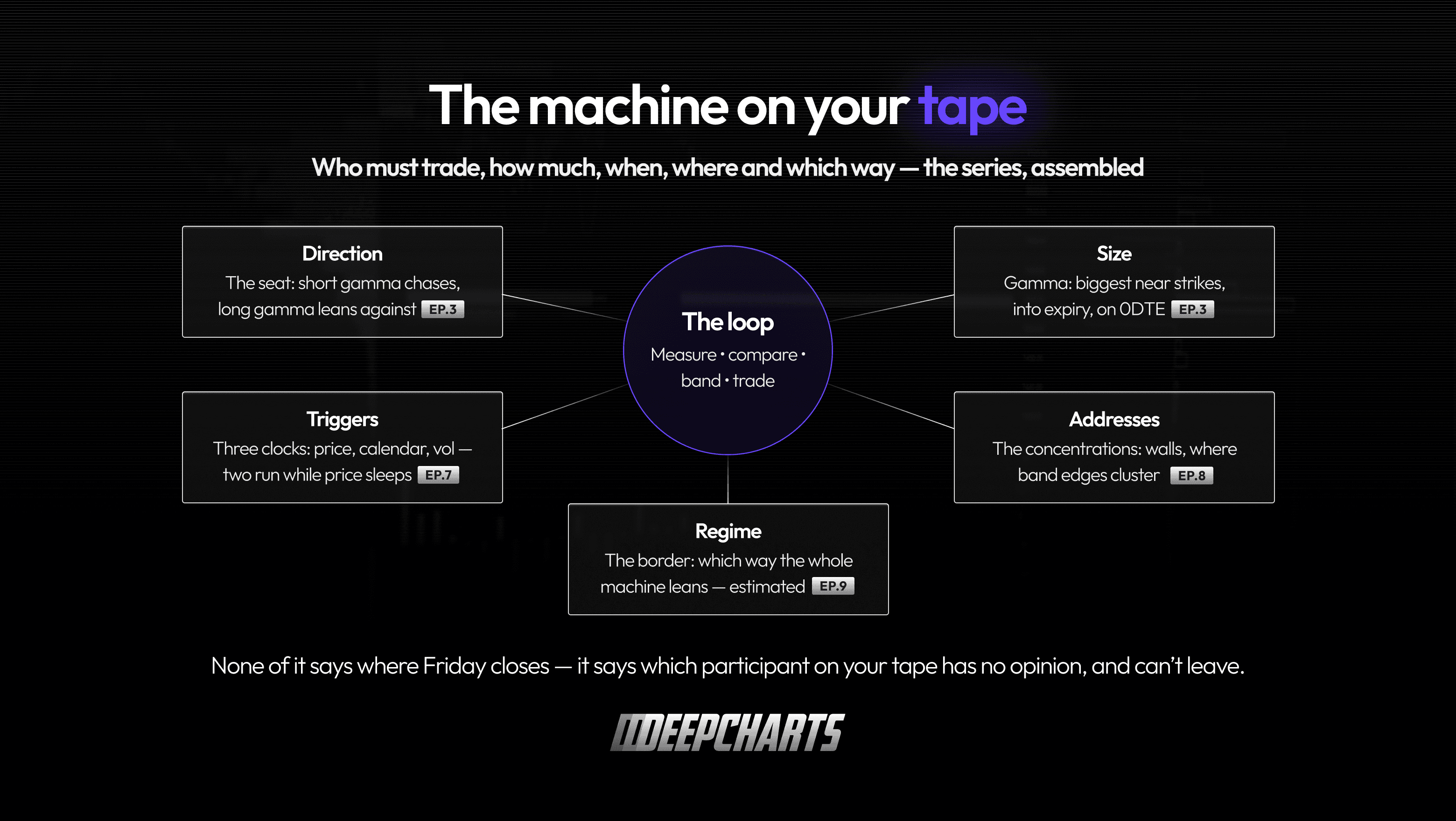
Figure 5 · The machine on your tape
The honest coda
Ten episodes of mechanics deserve ten seconds of epistemics, one last time.
The machine is real — the loop, the bands, the forced direction are how hedging desks actually operate. But your view of it is built: each desk’s bands, timing and netting are private; the aggregate book is reconstructed, not observed; the maps that locate the flow inherit every assumption we’ve catalogued. So the machine’s output reaches you as this series has always insisted it should: as tendencies with reasons and addresses — hypotheses to verify on the tape, never promises. The map proposes. The tape disposes. That sentence has appeared, in one form or another, in all ten episodes; it is the series.
And so, one line each, the whole journey: Delta is speed, odds and exposure. Gamma is the acceleration that forces the chase. Theta is the rent, and the rent runs rich. Convexity is the bend everyone pays for, in premium or in whipsaw. Vega prices movement itself. Vanna and charm move the hedges while price sleeps. The walls are where it all piles up. Zero gamma is the border, drawn in estimate. And dynamic delta hedging is the machine that turns all of it into flow on the chart in front of you.
The Greeks were never trivia. They’re the accounting system of the only player in the market who has to trade. Now you can read the books.

Figure 6 · The series, one line each
FAQ
What is dynamic delta hedging, in simple terms?
The continuous procedure by which option dealers keep their books directionally neutral: measure net delta, compare to zero, and trade index futures whenever the gap exceeds a tolerance band — then repeat, all session, because price, time and volatility keep moving delta.
Why do dealers hedge instead of just taking the risk?
Their edge is the option premium — structurally rich thanks to persistent protection demand — not directional forecasting. Hedging isolates that edge: they earn the rent while neutralizing the coin flip.
What are hedging bands?
Tolerance zones around the delta target. Re-hedging every tick burns transaction costs; re-hedging too rarely leaves unmanaged exposure that gamma grows fast. Desks act only at band edges — which is why mechanical flow arrives in pulses.
How do hedgers make money if they always buy high and sell low?
That adverse trading is the cost of realized movement, and it’s paid for by theta — the priced expectation of movement, collected daily. When the market moves less than implied vol priced, rent exceeds round-trips: the volatility risk premium, realized through hedging.
Does delta hedging move the futures market?
It contributes real, mechanical flow — direction set by dealers’ aggregate gamma seat, size by gamma, triggers by price, time and vol, locations by strike concentrations. On most tapes it’s one flow among many: a tendency with addresses, verified on the tape.
What’s the difference between static and dynamic hedging?
A static hedge is set once — sized to the exposure at inception and left alone. Dynamic hedging re-balances continuously as the exposure itself changes. Options require the dynamic kind, because their delta is a moving target by construction.
This concludes The Greeks, One at a Time. If you started here: the series begins with Option Greeks, explained — ten episodes, one machine, no promises. Just the tape, and more ways to read it.
Deepcharts Team
·
Share this on
