



Delta and gamma price where the market goes. Theta prices the waiting. Vega prices something stranger and more powerful: how much movement the market expects at all. It’s the Greek behind every “I was right and still lost money” story ever told — and the one that turns volatility itself into a market. Episode 6 of our Greeks series.

The third input
Strip an option’s price down to its inputs and you find three big levers: where the underlying trades, how long the option lives, and one number that isn’t a fact at all — implied volatility (IV), the amount of movement the market expects between now and expiry.
The first two you know from this series: delta and gamma handle the spot lever (Episode 2, Episode 3), theta handles the clock (Episode 4). Vega handles the third lever: it tells you how much the option’s value changes when implied volatility moves one percentage point. A vega of 0.40 means IV ticking from 18% to 19% adds about 0.40 to the option’s price — index untouched, calendar untouched.
Pause on how strange that is. An option can gain or lose meaningful value while nothing happens to the underlying — because the market changed its mind about what could happen. Options don’t just price direction; options price movement. Vega is the sensitivity to the market’s opinion of movement itself.
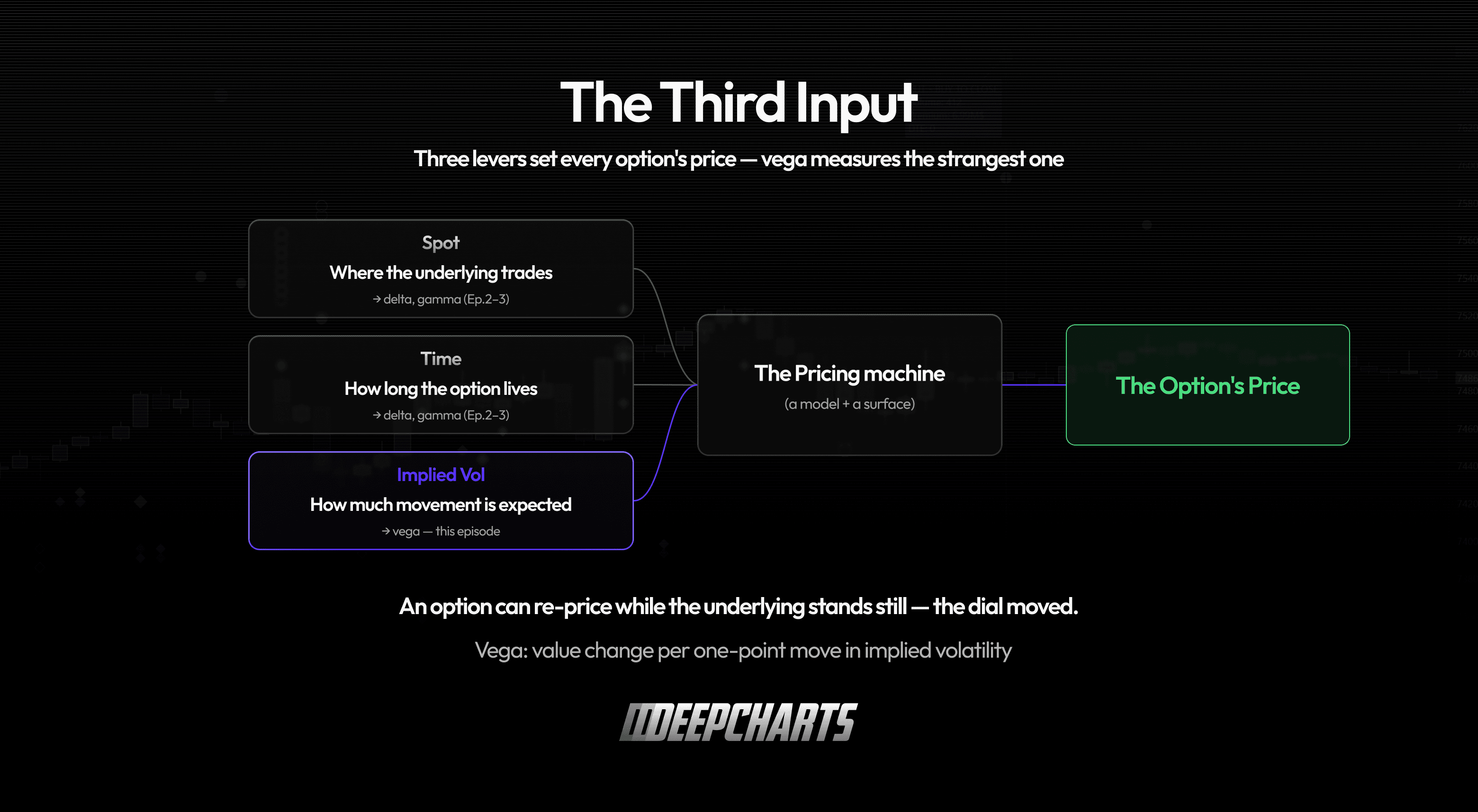
Figure 1 · The third input
IV is a price, not a forecast
A common beginner misreading: implied volatility is not someone’s prediction, published on a schedule. It’s a price — the level of expected movement implied by what people are actually paying for options, the same way a house’s value is implied by what buyers pay for houses. When demand for options rises, IV rises: movement got more expensive. When nobody wants protection or lottery tickets, IV sags: movement is on sale.
That reframe does a lot of work. “Is this option cheap?” stops being about the dollar premium and becomes a question about IV: cheap or expensive relative to the movement you expect to realize. It’s the exact comparison from Episode 4’s volatility risk premium — IV versus RV, the quote versus what shows up — now seen from the buyer’s side of the counter. Vega is the size of your bet on that comparison.
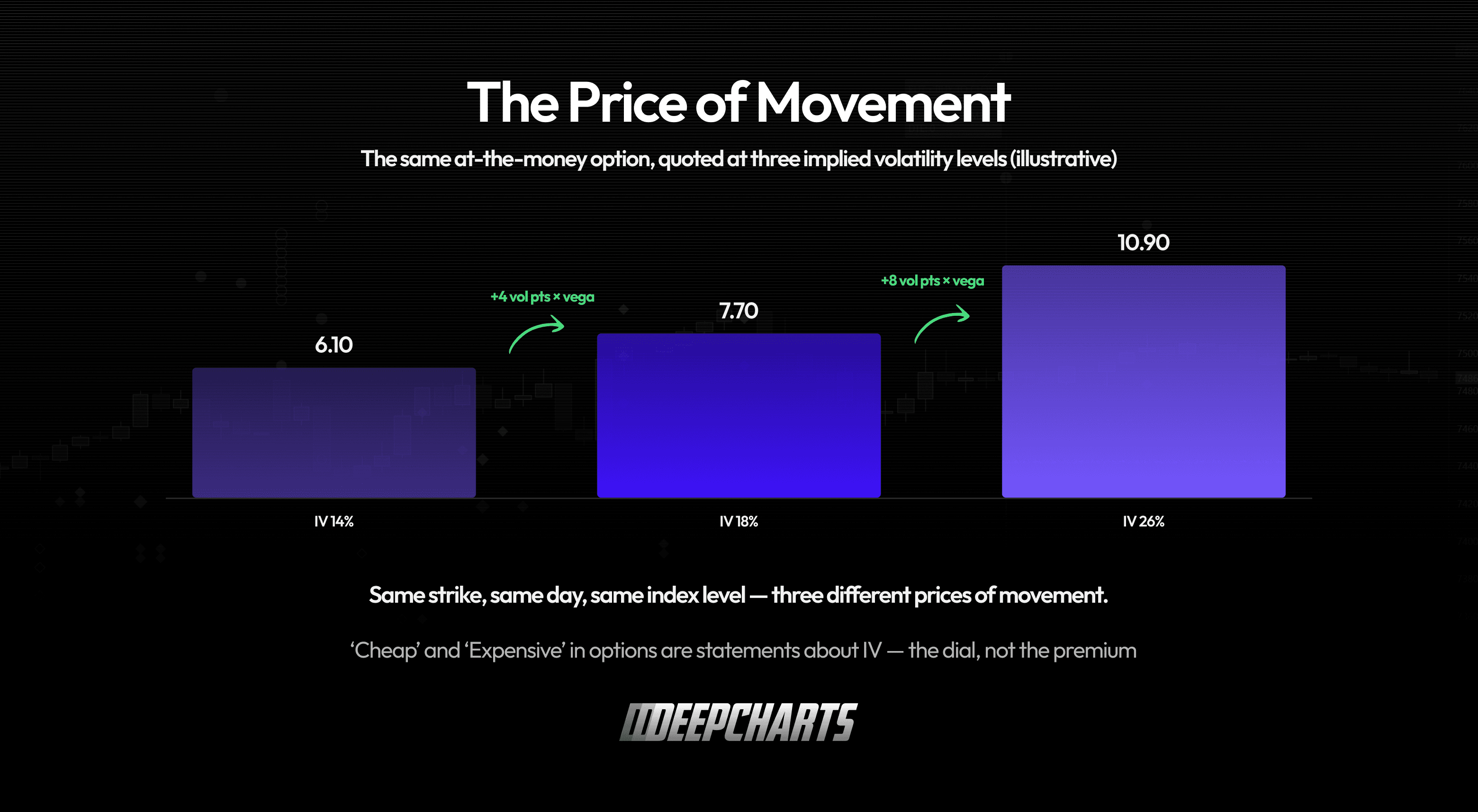
Figure 2 · The price of movement
Where vega lives (the mirror of gamma)
Vega concentrates at the money, like gamma and theta — by now you know that address: it’s where the outcome is most undecided, so it’s where the expectation of movement matters most.
But on the time axis, vega is gamma’s mirror image. Gamma explodes as expiration approaches: with an hour left, every point now violently rewrites delta. Vega does the opposite: it grows with time to expiry. A 0DTE option barely cares what IV does — there’s no future left to re-price. An option with six months of life is all future: change the expected movement per day and you’ve re-priced hundreds of days at once. Long-dated, at-the-money options are vega’s home turf.
Keep that mirror in your head, because it sorts the whole board: the front of the curve trades gamma; the back trades vega. The last-hour scalper and the six-month fund are both “trading options”, and they’re barely in the same business.
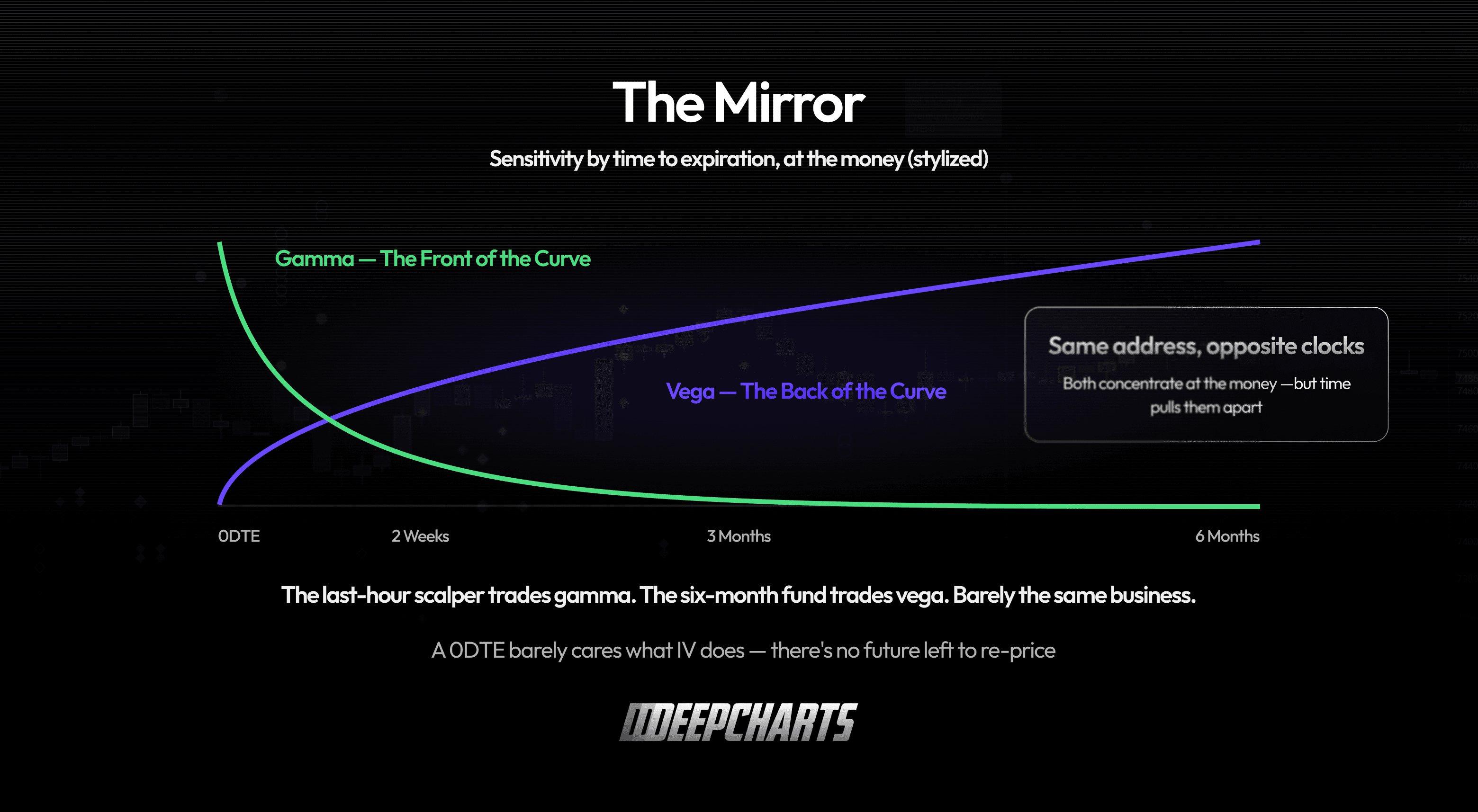
Figure 3 · The mirror
The heartbreak, anatomized
Now the story vega exists to explain. Earnings tonight. You expect a beat, you buy the call for 10.00. IV on that expiry is 45% — inflated, because everyone knows tonight is a coin flip worth insuring.
The beat arrives. The stock gaps up 3%. And your call opens at 9.20.
Nothing malfunctioned. Two forces pulled in opposite directions: delta made you money on the 3% move — call it +1.60. But the coin flip resolved: the uncertainty everyone was paying to hold overnight evaporated, IV collapsed from 45% to 28%, and at a vega of about 0.14 per point, that’s −2.40. Net: −0.80. Right on direction, wrong on movement — and movement was the bigger position.
This is the single most instructive loss in options, and vega is its name. Before the event you weren’t just long the stock’s direction; you were long the expectation of movement, at the exact moment that expectation peaked. The market charges admission for known storms. Sometimes the storm still outruns the ticket price — a 12% gap would have buried the crush. But “the stock moved my way” and “the option makes money” are two different sentences, and vega is the distance between them.

Figure 4 · Right, and losing
The market pre-prices storms
Generalize the earnings story and you get one of the most useful facts in this series: known events carry visible vol premium. Look at IV across expirations and you’ll find bumps sitting exactly on CPI mornings, Fed afternoons, earnings dates — the market pre-pricing each storm, expiry by expiry. After the event, that premium drains from the affected expirations within minutes. Nobody announces it; the repricing is the announcement.
Two practical readings follow. First, IV around an event is not “high” in any naive sense — it’s the market’s entry fee for holding risk through a scheduled unknown, and comparing that fee to what the event historically delivers is exactly the IV-versus-RV discipline from Episode 4. Second — and this is the honest caveat — elevated IV is information about attention, not direction. It says “the market expects movement here”; it says nothing about which way. Treat vol levels as context, never as a directional signal.

Figure 5 · Event premium
Why futures traders care
You trade the index, not implied volatility. But vega runs three channels straight into your tape.
IV sets the day’s expected stage. The index’s short-dated IV translates, arithmetically, into how much daily movement the option market has priced. That number is public knowledge, and it frames the session before it opens: a tape trying to break out of a range narrower than what vol priced is a different animal from one already exceeding it. Context, not prophecy.
Vol repricing forces re-hedging. When IV jumps or collapses, every option book re-prices — and the deltas of those books shift without price moving, because the whole ladder bends with the vol change. Dealers must adjust hedges on the futures accordingly. That vol-driven delta shift has a name — vanna — and it’s precisely where the next episode begins. Consider this the trailer: vol moves alone can generate mechanical futures flow.
Events structure the session. Pre-event: books hedged, vol bid, tape often compressed — the market literally paid to wait. Post-event: premium drains, hedges unwind, movement gets re-priced in both directions. The rhythm around CPI, FOMC and the big earnings nights isn’t mood; it’s vega filling and emptying, with hedging flow as the plumbing. Tendencies, as always — the tape gets the last word.
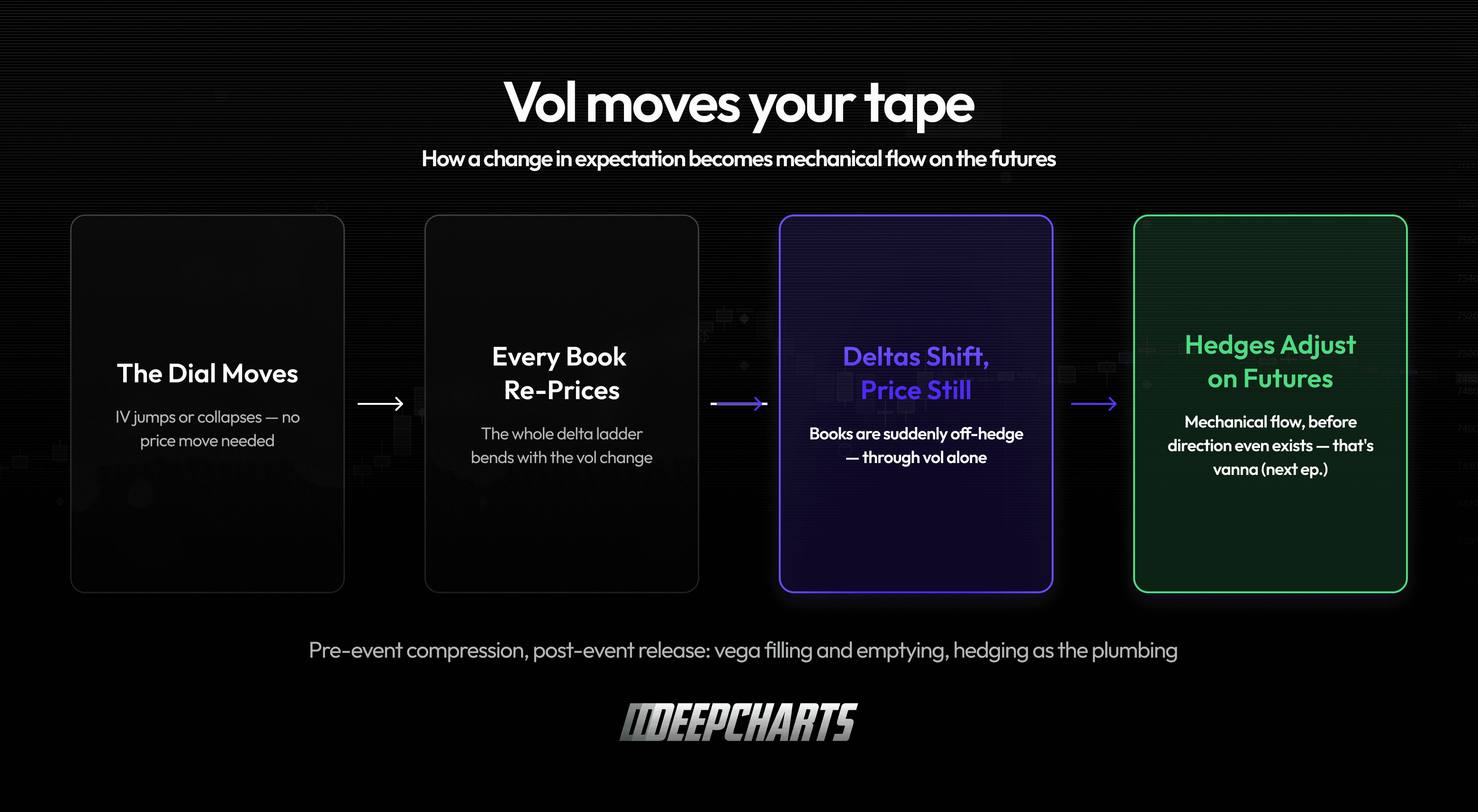
Figure 6 · Vol moves your tape
FAQ
What is vega in options, in simple terms?
Vega is how much an option’s value changes when implied volatility moves one percentage point. A vega of 0.40 means +0.40 if IV rises a point, −0.40 if it falls — even with the underlying unchanged.
What is IV crush?
The rapid collapse of implied volatility once a known event resolves. Options inflated by pre-event uncertainty lose that premium within minutes of the answer arriving — the classic reason a correctly-predicted earnings move can still lose money.
Why did my option lose value when the stock moved my way?
Because you were long two things: direction (delta) and expected movement (vega). If the vol collapse outweighs the directional gain, the net is negative. Before events, the vega position is often the bigger one.
Is high implied volatility good or bad?
Neither — it’s a price. High IV means movement is expensive: bad for buyers as an entry fee, attractive for sellers as rent (Episode 4’s premium). Judge it against the movement you actually expect to realize, not against its own history alone.
Does vega matter for futures traders?
Yes, indirectly: short-dated index IV frames the session’s expected range, and vol repricing shifts option books’ deltas — forcing dealer re-hedging on futures even before price moves. That channel, vanna, is the next episode.
Episode 7: vanna and charm — the two quiet Greeks that move delta when nobody’s touching price.
Deepcharts Team
·
Share this on
